
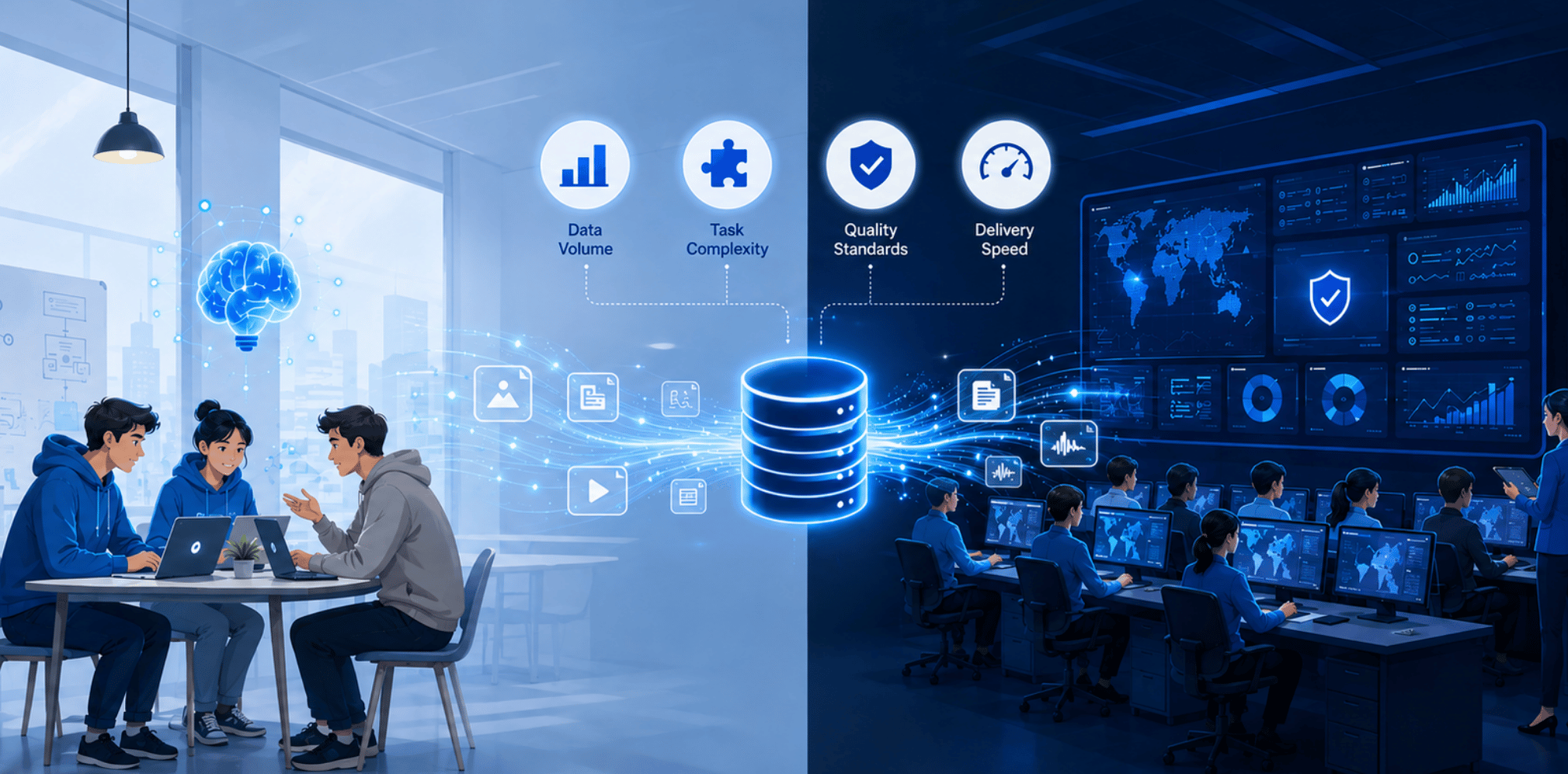
| Executive Summary Understand how data annotation needs vary between startups and enterprises based on team size, complexity, quality requirements, and turnaround expectations. This blog explains how organizations build the right human-in-the-loop annotation model for their AI projects. It explores how specialized teams support early-stage AI development, while enterprise programs require scalable workflows, strong quality controls, and continuous delivery. Learn why the right annotation strategy depends on the use case, not just the size of the organization |
Enterprise vs. Startup Data Annotation Needs: How Team Size and Turnaround Vary by Use Case
How much data annotation capacity does an AI project actually need?
For a startup experimenting with its first production model, the answer may be a small team of highly trained specialists working through rapidly changing annotation guidelines. For a large enterprise operating AI at scale, the requirement may involve hundreds of reviewers, multiple quality layers, defined service-level agreements and continuous delivery.
But company size alone does not determine the answer.
A highly specialized startup use case can require more expertise per annotation than a high-volume enterprise workflow. Likewise, a large enterprise running an early proof of concept may need only a small specialist team.
At NextWealth, we see this variation across AI data programs. The right team size is determined less by whether an organization is a startup or an enterprise and more by what the use case actually demands. Our data annotation services are built around that principle.
Data annotation team size and turnaround are shaped by task complexity, data volume, domain expertise, quality thresholds, workflow design, automation and the speed at which validated data must return to the AI system.
This distinction matters when organizations evaluate data annotation services or consider working with a data annotation outsourcing company. The objective should not be to find an arbitrary number of annotators. It should be to design the right human-in-the-loop operation for the stage and requirements of the AI system.
Startup vs. Enterprise Data Annotation: What Is Actually Different?
Startups and enterprises often begin from different operational positions.
A startup may still be validating its product, refining its ontology or discovering which edge cases matter most. Annotation requirements can change quickly as the model evolves. Smaller batches, close interaction with annotators and rapid feedback may therefore be more valuable than a large workforce.
An enterprise production environment typically introduces additional requirements. Data volumes may be continuous, turnaround commitments more rigid, downstream business risk higher, and quality needs more formalized. Workforce planning, escalation paths, audit mechanisms and integration with existing AI pipelines become much more important.
However, these are operating patterns rather than hard rules, as the comparison below shows.
Dimension | Startup / Early-Stage AI Program | Enterprise / Production-Scale AI Program |
Primary focus | Model learning and validation | Reliability and operational scale |
Data volume | Often smaller or evolving | Often continuous and high-volume |
Guidelines | Frequently changing | More standardized and governed |
Workforce design | Specialist, flexible teams | Structured, scalable teams |
Turnaround | Iteration-driven | SLA or production-cycle driven |
Quality focus | Reliable ground truth | Consistency at scale |
Automation | Introduced as workflow stabilizes | Integrated into production workflows |
Governance | Lightweight but controlled | Multi-layer QA, audit and escalation |
Key risk | Learning from poor-quality data | Errors multiplying at production scale |
The important point is that neither operating model is inherently better. Each needs to be designed around the AI use case, maturity of the workflow and business objective.
For Startups, Annotation Often Begins With Learning — Not Scale
Comparative TCO Matrix
Early AI programs frequently face uncertainty. The model is changing. The taxonomy is changing. The team is discovering new edge cases. Data scientists may not yet know which failure modes will have the greatest impact on production performance.
In this environment, scaling the annotation workforce too early can create additional complexity. Every new reviewer has to interpret the annotation guidelines consistently. If those guidelines are still evolving, a larger workforce can increase disagreement, retraining effort and rework.
That is why a focused specialist team can sometimes create more value during an early stage.
At NextWealth, one of our geospatial AI engagements illustrates this well. AI-generated farmland polygons contained inaccurate boundaries, false-positive non-farmland regions and incomplete coverage. Our HITL specialists reviewed and refined those boundaries, removed false positives, resolved coverage gaps and applied standardized quality checks.
The operation covered 110 geo-region datasets with a team of three specialists.
The lesson is not that a startup requires three annotators. It is that specialized annotation does not automatically require a large team. When complexity is high but volume is controlled, expertise and calibration can matter more than headcount.
This is particularly relevant in computer vision, geospatial AI, medical AI, autonomous systems and other domains where an individual annotation can require substantial contextual judgment. Our approach is to understand the task first, identify where specialist judgment is required, and then build the delivery model around that requirement.
Enterprise Data Annotation Is Usually an Operating-System Problem
The challenge changes when AI reaches production volume. At this stage, annotation is no longer simply a temporary activity required to create a training dataset. It may become part of a continuous model-training, evaluation or validation loop.
In one of our large-scale product intelligence programs at NextWealth, we supported a leading omnichannel retailer in comparing products across competitor ecommerce websites. Our workflow combined product normalization, model-output validation, attribute verification, exception resolution and rigorous quality governance to support accurate matching at enterprise scale.
Through this operating model, our team processed more than 100 million product comparisons with 490 associates, maintained 99% accuracy, reduced average handling time by 10%, and supported both 24-hour and intraday turnaround commitments.
The important conclusion is not that enterprise data annotation requires 490 associates. It is that once volume, delivery frequency, quality requirements and exception complexity increase together, the operating model must become more sophisticated.
At that scale, workforce alone is not enough. The operation also needs workflow standardization, trained reviewer pools, capacity management, calibration, quality analytics, exception handling and technology integration. This experience reinforces a principle we see across our AI data operations: enterprise-scale delivery is about designing the right combination of trained talent, technology-enabled workflows, exception management and quality governance around the volume and turnaround the use case demands.
Team Size Should Follow Task Complexity
One of the biggest mistakes in annotation planning is assuming that dataset size directly determines workforce size. It does not.
The amount of effort behind an annotation varies enormously. Classifying whether an image contains a particular object may take only a short amount of time. Drawing precise polygons around irregular boundaries requires more judgment. A 3D LiDAR cuboid requires an entirely different skill set. Evaluating an LLM response for factuality, instruction adherence and taxonomy compliance involves another type of cognitive workload.
This is why a million annotations cannot automatically be translated into a fixed number of annotators. The unit of work matters.
Across NextWealth’s AI data programs, our teams work with different annotation and validation requirements, including object detection, segmentation, video annotation, LiDAR workflows, model-output validation and human evaluation.
For a startup team, this may mean selecting a small group of reviewers with deep task familiarity. For an enterprise, it may mean creating different reviewer layers production annotators, quality reviewers, domain specialists and escalation teams. The team structure should follow the complexity of the decision being made.
Domain Expertise Can Matter More Than Dataset Size
Data annotation is often described as if every task can be performed by any trained annotator. That is not always true.
Healthcare data can require understanding of clinical terminology and coding structures. Multilingual annotation requires linguistic as well as contextual understanding. Generative AI evaluation can require reviewers capable of assessing factual accuracy, taxonomy compliance and instruction-following. Automotive annotation can demand understanding of complex spatial relationships across image, video and LiDAR data.
One of our healthcare AI programs at NextWealth illustrates how domain complexity changes the operating requirement. The process involved annotating diagnoses, procedures, complaints and medical history from discharge summaries, alongside IRDA classification and ICD validation. Fifteen associates processed more than 11,000 transactions at 98% quality with a 24-hour turnaround.
The more important takeaway is that usable annotation capacity means domain-ready capacity. Having hundreds of available reviewers does not automatically mean those reviewers are ready for a specialized healthcare, geospatial, automotive or GenAI workflow.
At NextWealth, we therefore build capacity around the skills required for the process. Reviewer assessment, project-specific training, calibration and ongoing quality feedback help prepare our teams for the actual decisions they need to make.
Turnaround Time Is Not the Same as Team Size
A common buyer question is: “How large a team do we need to achieve a 24-hour turnaround?” There is no reliable universal answer. A 24-hour TAT may be achievable with 15 people in one workflow and require hundreds in another.
That difference exists because turnaround is determined by the complete operating equation:
Incoming volume × effort per task × quality-review requirement × demand variability ÷ productive capacity
For startups, turnaround may be driven by model iteration. A machine-learning team may need the next validated batch quickly so it can retrain and evaluate the model. For an enterprise, turnaround may be connected to a production SLA, where new data continuously enters the workflow and must be processed before a customer-facing system, recommendation engine or model-evaluation pipeline can proceed.
The same 24-hour target can therefore represent two completely different operational requirements. When we design an annotation workflow at NextWealth, we do not look at TAT in isolation. We consider the unit of work, handling time, daily and peak volumes, quality controls, exception patterns and opportunities for automation before determining the appropriate workforce.
Human-in-the-Loop Annotation Changes the Scaling Equation
As AI automation improves, data annotation is increasingly moving away from a model in which humans create every label manually. Instead, machines and humans divide the work: AI systems generate a prediction or first-pass annotation, and human reviewers validate it, correct mistakes, investigate uncertain cases and return high-quality feedback to the model.
One of our retail AI programs demonstrates how this can change workforce productivity. AI-generated product attributes could contain inaccurate information, offensive terminology or counterfeit indicators. Our reviewers validated model-predicted values against product information and category guidelines, corrected inaccurate data, flagged problematic content and applied quality controls before those attributes reached customers.
A team of 35 associates validated more than 6 million attributes at 98% accuracy while supporting a 24-hour TAT, and productivity increased from 1,800 to 2,250 attributes per associate per day.
The value of HITL here is not simply additional human review — it is using human judgment selectively. A mature workflow can look like: AI prediction → Human validation → Exception resolution → Quality assurance → Feedback.
For a startup, this can help concentrate limited annotation capacity on the model’s most uncertain or important examples. For an enterprise, it can help prevent human workload from growing at exactly the same rate as data volume. Our role is to determine where human judgment adds the most value and design the workflow around those decision points.
AI Training Data Quality Becomes More Complex as You Scale
Startups and enterprises also experience quality differently. During early model development, quality is often about establishing dependable ground truth if the labels are wrong, the team cannot confidently determine whether poor performance comes from the model or from the training data.
At enterprise scale, the challenge increasingly becomes consistency. A small error rate across a limited dataset and the same error rate across millions of records have very different operational consequences.
This is why AI training data quality should not be viewed only as a final accuracy percentage. Depending on the task, quality may also need to consider precision, recall, completeness, First-Time-Right performance, reviewer consistency and inter-annotator agreement.
At NextWealth, our quality framework is designed around the requirements of each engagement, including direct measurement, random validation, maker-checker controls, double-blind processes, Golden Datasets and agreement-based quality measures. Quality governance is not only about inspecting completed work — it is also about understanding why errors occur, identifying edge cases, improving reviewer consistency and refining the workflow as the underlying data changes. That becomes especially important at enterprise scale, where small patterns of inconsistency can otherwise become large downstream problems.
What Changes When Language Becomes Part of the Annotation Requirement?
Multilingual data provides another useful example of why workforce numbers alone can be misleading. In one of our retail operations at NextWealth, model-generated Spanish product attributes needed to be validated and enriched for a large ecommerce catalog. Our team reviewed model-generated suggestions, corrected inaccurate or incomplete content, and applied consistency checks before final submission.
The workflow used 100 associates, processed more than one million records, achieved 98% accuracy and supported a 24-hour turnaround, with productivity improving by approximately 10%.
The requirement was not simply for 100 people, it was for reviewers with the right combination of language capability, product context, localization knowledge and process training. This distinction matters for both startups and enterprises expanding AI products into new markets.
A startup may initially need a small group of bilingual reviewers to validate a model in one additional language. An enterprise expanding across multiple regions may need a multilingual workforce supported by common taxonomies, reviewer calibration and structured quality governance. The required headcount may change dramatically, but the underlying principle remains the same: annotation capacity is skill-specific capacity.
Startup vs. Enterprise: What Should You Optimize First?
A startup should often optimize first for learning velocity, obtaining enough high-quality, representative data to understand whether the model is improving. Small-batch annotation, rapid feedback and close interaction between reviewers and ML teams can be more valuable than creating a large annotation operation before the workflow is mature.
An enterprise increasingly needs to optimize for reliable production throughput. Can incoming volume be absorbed without creating a backlog? Can quality remain stable across reviewers and shifts? Are difficult edge cases escalated correctly? Can workload spikes be handled without breaking the SLA? Can validated data return to model-development or production workflows without operational friction?
These are different objectives, and the operating model should be designed differently for each.
When Should a Startup Consider Data Annotation Outsourcing?
Startups often begin with founders, ML engineers or internal team members performing annotation themselves. That can work during initial experimentation, but the model becomes difficult to sustain once annotation starts consuming engineering time, domain expertise is required, datasets become larger or quality inconsistency begins to affect model evaluation.
At that point, data annotation outsourcing can help convert annotation from an ad hoc activity into a defined process. For an early-stage AI company, outsourcing does not have to mean immediately creating a large external workforce.
At NextWealth, an engagement can begin with a calibrated specialist team, clearly defined annotation guidelines and a structured feedback mechanism aligned with the customer’s ML workflow. The important requirement at this stage is flexibility as the ontology, model and product evolve, the annotation process needs to evolve with them.
What Should Enterprises Expect From Data Annotation Services?
Enterprises require the same fundamental annotation expertise, but usually with additional operational capabilities around it. At production scale, a data annotation partner may need to integrate with existing tooling, manage high-volume task queues, operate against defined SLAs, provide specialist escalation and maintain consistent quality across long-running programs. Our guide to evaluating data annotation companies covers the certifications and quality benchmarks worth checking before you commit.
At NextWealth, we approach this as a broader Human-in-the-Loop operating model rather than viewing annotation as a standalone manual task. Depending on the engagement, our teams can support training-time annotation, model-output validation, human evaluation, feedback workflows, specialized quality operations and scalable data-processing workflows.
The scale of the workforce matters in enterprise delivery, but scale alone is not the value proposition. The value comes from combining capacity with domain-specific training, structured workflow design, technology-enabled operations, rigorous quality governance and continuous improvement.
How Should You Estimate the Right Annotation Team?
Instead of starting with a headcount target, organizations should first define the operating requirements:
- What is the unit of work? A classification, polygon, segmentation mask, LiDAR cuboid, product match or LLM evaluation will each have a different effort profile.
- How much data will arrive? Consider average volume, peaks, backlog and expected growth.
- How complex is the judgment? Identify where domain expertise, language capability or escalation is required.
- What does acceptable quality mean? Define the accuracy and consistency measures appropriate for the task.
- How fast must validated data return? Batch, daily and intraday workflows require different capacity models.
- What can be automated? AI-assisted pre-annotation and model-generated predictions can significantly change human workload.
- How variable is demand? Production systems should be designed for peaks, not only averages.
Once these variables are understood, team size becomes a design decision rather than a guess. A more practical sequence is:
Use case → Task complexity → Volume → Quality model → Productivity → Turnaround → Workforce
rather than: Available annotators → Project.
Choosing a Data Annotation Outsourcing Company
Whether you are a startup or an enterprise, workforce size alone is a weak way to evaluate an annotation provider. The better question is whether the partner can design the operation around your AI system.
Can the provider identify the right reviewer profile? Can teams be calibrated as guidelines change? Can model-generated outputs be incorporated into the process? Can difficult edge cases move to specialists? Can quality be measured consistently? Can the operation expand without losing control?
For an enterprise, the added question is whether those controls remain effective when the workflow reaches millions of transactions. For a startup, it is whether the process can remain flexible enough to change as the model evolves.
At NextWealth, we see both requirements as part of the same design challenge: building a Human-in-the-Loop operation that fits the AI system today and can evolve as the customer’s requirements change.
Our Approach to Data Annotation at NextWealth
We do not treat data annotation as a standalone manual labeling activity. We see it as one part of a broader Human-in-the-Loop AI operating model, combining specialist talent, technology-enabled workflows and quality governance according to what the use case actually requires.
That may mean a small group of specialists for a complex geospatial workflow, domain-trained reviewers for healthcare annotation, humans validating millions of AI-generated catalog attributes, or a large delivery team supporting continuous product intelligence at enterprise scale. For programs centered on model alignment and feedback, this extends into our RLHF and Gen AI annotation services as well.
The operating models can look very different because the underlying problems are different. That is intentional. Our objective is not to fit every project into one standard delivery structure, it is to determine where human judgment is required, how that judgment should be measured, which portions of the workflow can be technology-assisted, and how the process can scale without compromising quality.
That is why the numbers across our engagements should not be interpreted as benchmarks. They demonstrate a more useful principle: the right data annotation operation is the one designed around the use case.
Conclusion
the internal AI team to build and operate the entire annotation function itself. The appropriate outsourcing model depends on the maturity and requirements of the AI system.
What Should I Look for in a Data Annotation Outsourcing Company?
Look for task and domain expertise, reviewer training, measurable quality controls, scalable capacity, workflow technology, exception management, security, turnaround performance and the ability to integrate human feedback with the AI lifecycle.
The biggest difference between startup and enterprise data annotation is not simply team size. It is what the organization needs the annotation operation to accomplish.
A startup may need a small expert team that helps the model learn quickly and adapts as the product changes. An enterprise may need a production-grade operation capable of processing continuous data, maintaining consistent quality and meeting strict turnaround commitments. But the use case always matters: a complex early-stage workflow can demand more specialist judgment than a relatively straightforward enterprise task, while high-volume production AI may require hundreds of trained reviewers even when automation supports significant portions of the workflow.
At NextWealth, our approach is to combine specialist human judgment, Human-in-the-Loop workflows, technology-enabled delivery, scalable operations and rigorous quality governance according to what the AI system actually requires.
The question for AI leaders is therefore not “Are we a startup or an enterprise, and how many annotators should we have?” It is: “What annotation operating model will give our AI system the right quality, feedback and turnaround at its current stage — and continue to scale as those requirements change?”
Not sure what that operating model looks like for your AI program? Book a free POC with NextWealth and we’ll assess your data, volume and quality requirements before recommending a team structure – no commitment required.
Frequently Asked Questions
How Many Data Annotators Does a Startup Need?
There is no standard number. A startup’s annotation team should be based on data volume, task complexity, expertise required, quality targets and speed of model iteration. Early-stage projects can often benefit from smaller, highly calibrated teams before scaling headcount.
How Is Enterprise Data Annotation Different?
Enterprise data annotation usually introduces requirements such as continuous high volumes, formal turnaround SLAs, multi-level quality controls, specialist escalation, workforce planning, technology integration and long-term operational consistency.
Does a 24-Hour Turnaround Require a Large Annotation Team?
Not necessarily. Team size depends on the volume entering the workflow, effort per task, reviewer productivity, quality requirements and automation. Different team sizes can support the same turnaround when the underlying workloads are different.
What Is Human-in-the-Loop Annotation?
Human-in-the-loop annotation combines AI automation with structured human judgment. Human specialists may create training labels, validate model predictions, resolve uncertain outputs, correct errors and provide feedback that supports model improvement.