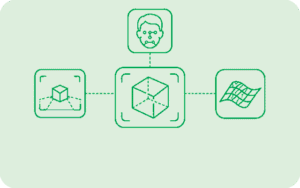

Visual Commerce & Virtual Try-On Prep
High-fidelity polygon annotation and semantic segmentation of apparel and products to feed augmented reality (AR) shopping engines.

Types of Visual Commerce & Virtual Try-On Prep Services

High-Fidelity Polygon Annotation & Edge Masking
- Sub-Pixel Boundary Tracing: Delineates intricate object edges, fine garment silhouettes, lace textures, and complex patterns with pinpoint accuracy.
- Occlusion & Layer Handling: Annotates overlapping visual elements (e.g., jackets over shirts, straps over shoulders) for realistic depth layering in AR environments.
- Transparency & Material Alpha Channeling: Extracts sheer fabrics, mesh materials, eyewear lenses, and glass reflective boundaries for photorealistic AR blending.
Multi-Class Semantic & Instance Segmentation
- Component-Level Garment Partitioning: Segments apparel into granular anatomical components (e.g., sleeves, collars, lapels, buttons, seams, hemlines) for physics-based cloth simulation.
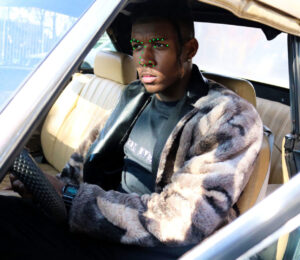
- Facial & Body Landmark Keypointing: Maps 68+ facial keypoints and full-body skeletal posture joints to anchor virtual eyewear, cosmetics, jewelry, and watches.
- Spatial Surface & Plane Masking: Segments floor boundaries, wall planes, and surface textures for 3D furniture and home decor spatial placement engines.


2D-to-3D Asset Preprocessing & Mesh Structuring
- 3D Mesh Point-Cloud Alignment: Prepares multi-angle 2D studio imagery to train NeRF (Neural Radiance Fields) and Gaussian Splatting models for instant 3D mesh generation.
- Texture & UV Map Segmentation: Isolates surface patterns, fabric weaves, and material finishes to apply accurate lighting and physics rendering across 3D digital twins.
- Color & Shader Calibration: Standardizes color profiles and specular maps across dynamic ambient lighting conditions to ensure true-to-life product representation.
Synthetic Data Generation & Augmentation Prep
- Pose & Lighting Variation Annotation: Annotates diverse human body shapes, skin tones, postures, and dynamic lighting conditions to prevent model bias in VTO engines.
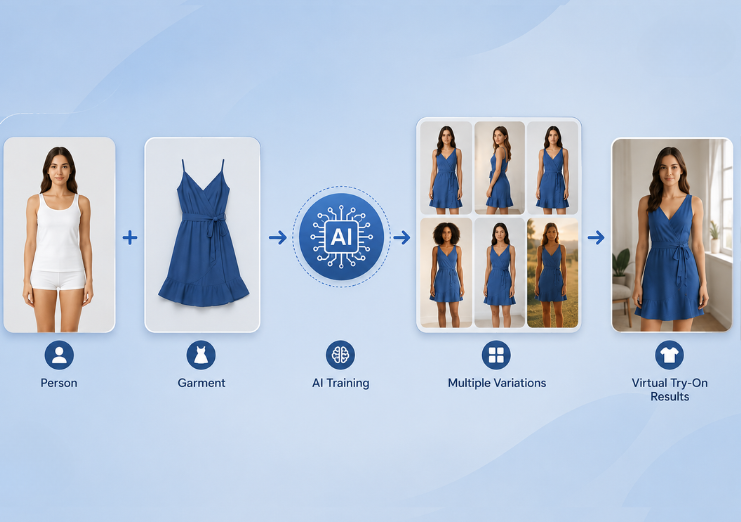
- Generative AI VTO Training Data: Structures high-quality ground-truth paired datasets (e.g., person + flat-lay garment -> dressed person) to train diffusion-based try-on algorithms.
Apparel & Luxury Fashion

VTO / AR Data Challenge:
Inaccurate garment fitting and poor cloth draping in virtual dressing rooms lead to user distrust.
Business Impact & Outcome:
Increases conversion rates by up to 40% and reduces size-related apparel returns by 30%.
Eyewear & Accessories

VTO / AR Data Challenge:
Misaligned 3D frames on user faces due to low-precision facial landmark mapping.
Business Impact & Outcome:
Delivers millimetric frame alignment across diverse head shapes, driving 3x higher VTO engagement.
Beauty & Cosmetics
VTO / AR Data Challenge:
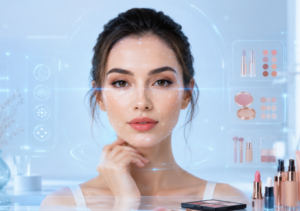
Unrealistic virtual makeup overlays fail to adapt to skin texture and ambient lighting.
Business Impact & Outcome:
Enables realistic, real-time lipstick, foundation, and eye shade try-ons with 98% color fidelity.
Home Furnishings & Spatial Decor

VTO / AR Data Challenge:
Furniture models clip into floors or appear to float due to poor boundary and surface segmentation.
Business Impact & Outcome:
Improves AR spatial placement realism, boosting high-value furniture purchase confidence by 2.5x.



I am really happy at all the great things we have been able to achieve in the past 1 year. The relationship now has a solid foundation, and I am sure NextWealth will continue to be a formidable partner going ahead, bringing a delightful experience for our customers.
NextWealth has been an invaluable partner to us, significantly accelerating our growth by handling critical data operations and providing strategic insights.
NextWealth’s hard work and dedication are truly making a difference, streamlining our processes significantly. We really appreciate it!
My experience with NextWealth has been wonderful. The diligent team consistently delivers on time with a focus on quality. Their innovation-driven mindset fosters a win-win situation for both teams.
I am happy with the improvement in the performance. I have seen positive improvement, and we have a long way to go.
NextWealth’s in-depth analysis helped us pinpoint exactly what needs to be done to address the issues.
With excellence in Quality, Cost, and TAT—key pillars of any operation—NextWealth sets a benchmark for operational efficiency and beyond.
We have experienced significant growth—a success we could not have achieved without the expert support, hard work, and commitment of NextWealth.