
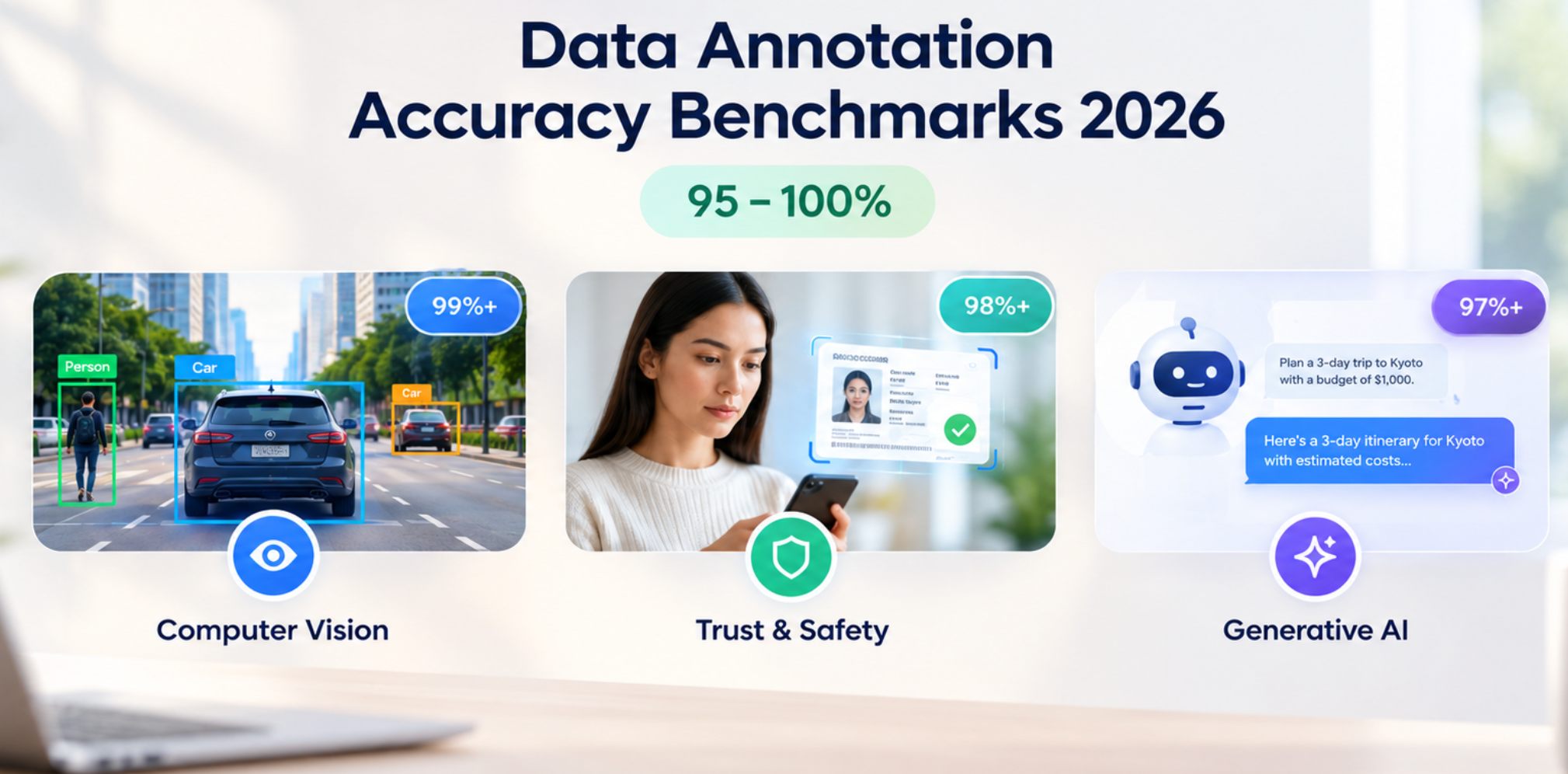
| Executive Summary Explore key data annotation accuracy benchmarks for 2026 across computer vision, Trust & Safety, and Generative AI workflows. This blog highlights how enterprises measure quality through audited accuracy, QA processes, and human-in-the-loop validation across large-scale AI projects. It covers real-world benchmarks ranging from 95% to 100% accuracy, including LiDAR annotation, image annotation, identity verification, and RLHF evaluations. Learn how organizations build reliable AI systems by balancing precision, scalability, and operational quality. |
What Is a Good Data Annotation Accuracy Rate in 2026?
What Is a Good Data Annotation Accuracy Rate in 2026?
For enterprise AI programs, data annotation accuracy is about more than just whether a label is marked correctly on a single pass. The true benchmark is whether high precision can be sustained across complex edge cases, massive production scale, and tight operational turnaround requirements.
Across NextWealth’s enterprise client engagements in computer vision, Trust & Safety, and Generative AI, structured production workflows routinely deliver 95% to 100% audited accuracy or quality, depending on task complexity and domain constraints.
However, accuracy cannot be measured with a one-size-fits-all metric:
- Computer Vision relies on spatial precision, measured through Intersection over Union (IoU) and consensus scoring.
- Trust & Safety depends on policy compliance and multi-pass audit agreement.
- Generative AI & RLHF evaluate qualitative human alignment, instruction adherence, and factual precision.
When evaluating a data annotation service, the critical question for enterprise buyers is: What audited accuracy has been demonstrated on a comparable AI workload at production scale?
Data Annotation Accuracy Benchmarks at a Glance
Use Case / Domain | Reported Accuracy / Quality | Measurement Methodology | Production Scale |
Security 2D & 3D Imagery | 99.93% Accuracy | Multi-pass consensus & IoU audit | 1.5M+ 2D & 280K+ 3D images |
RFID Self-Checkout Validation | 100% Audit Sample Agreement | Dual-review verification on flagged events | 7.5K+ validated events |
Packaging Defect Segmentation | 99.63% Precision | Multi-tag pixel segmentation QA | 1.7K+ production tasks |
3D LiDAR Annotation | 98% Accuracy | Bounding box / point-cloud QA audit | 525 associates |
Identity Verification | 98.99% Accuracy | Standardized QA sample audit | 74.8M+ transactions |
E-Commerce Conversational AI (SFT + RLHF) | 97.4%+ Quality | Inter-annotator agreement (IAA) & preference scoring | 210K+ evaluations |
AI Response Moderation | 98% Quality | Policy compliance spot-check QA | 332 peak reviewers |
Computer Vision Annotation Accuracy Benchmarks
Modern computer vision solutions depend on reliable ground-truth data. Small labeling errors or imprecise polygon boundaries directly degrade object detection, model precision, recall, and downstream automated action.
For teams evaluating image annotation services, spatial complexity matters as much as the headline percentage.
Security AI Training Data: 99.93% Accuracy
- Challenge: A global threat-detection enterprise required high-precision annotated security imagery to train AI models to detect dangerous objects and contraband. The workflow involved non-standard x-ray formats, complex 2D polygon annotation, and 3D mask segmentation.
- Result: NextWealth achieved a 99.93% audited accuracy rate across 1.5M+ 2D images and 280K+ 3D images.
- Takeaway: Polygon and 3D mask annotations require significantly higher spatial precision than basic bounding boxes or classification tags. Achieving near-perfect precision across millions of images requires automated pre-checks combined with expert multi-pass QA.
RFID Self-Checkout Validation: 100% Audit Accuracy
- Challenge: A major retail enterprise required human validation of automated RFID detection events during self-checkout to eliminate false positives and prevent loss.
- Result: Specialists reviewed flagged transaction videos to verify item additions, removals, and discrepancies, achieving 100% accuracy on client audit samples across 7.5K+ events while reducing average handling time (AHT) by 13.3%.
- Takeaway: This illustrates human-in-the-loop AI in production: the AI system flags low-confidence events, and human specialists deliver definitive validation without interrupting customer checkout.
Packaging Defect Segmentation: 99.63% Accuracy
- Challenge: For a warehouse automation and quality inspection program, NextWealth applied image segmentation and multi-defect tagging to train defect-detection models.
- Result: The team delivered 99.63% precision across 1.7K+ complex tasks.
- Takeaway: High-precision computer vision annotation directly improves industrial defect detection and supply chain automation by lowering false rejection rates.
3D LiDAR Annotation: 98% Accuracy at Scale
Takeaway: The benchmark here lies in maintaining strict quality controls across a massive, rapidly onboarded workforce handling complex 3D point-cloud data.
Challenge: A leading technology provider needed large-scale 3D LiDAR cuboid annotations for Autonomous Driving Assistance Systems (ADAS).
Result: NextWealth scaled operations to 525 trained associates, maintaining 98% bounding-box accuracy and 100% SLA compliance.
Trust & Safety Accuracy Benchmarks
In Trust & Safety, validation errors carry immediate financial, regulatory, and reputational risks. High-accuracy human oversight ensures compliance without adding unnecessary user friction.
Identity Verification: 98.99% Accuracy Across 74.8M+ Transactions
- Challenge: A global identity verification provider needed 24/7 document authentication across international markets to combat fraud while staying compliant with privacy regulations.
- Result: Supported by ~1,200 specialized reviewers, NextWealth sustained a 98.99% accuracy rate across 74.8M+ identity transactions, achieving 101% target productivity with an average handling time (AHT) of 84.3 seconds.
- Takeaway: At enterprise scale, the core operational hurdle is maintaining consistent decision quality across millions of transactions while meeting strict turnaround SLAs.
Generative AI Data Annotation Benchmarks
Generative AI requires a fundamental shift in annotation methodology. Traditional annotation asks binary questions (“Is there a vehicle in this frame?”). Gen AI data annotation requires evaluating nuanced dimensions such as context, instruction alignment, factual precision, and safety.
Quality in Gen AI is typically measured through Inter-Annotator Agreement (IAA), preference ranking consistency, and policy adherence scoring.
E-Commerce Conversational AI SFT + RLHF: 97.4%+ Quality Score
- Challenge: Supporting a major enterprise virtual shopping assistant required Supervised Fine-Tuning (SFT) and Reinforcement Learning with Human Feedback (RLHF).
- Result: AI trainers generated complex multi-turn shopping prompts and ranked model outputs based on relevance, helpfulness, and intent preservation. The program achieved 97.4%+ quality across 210K+ evaluations and 12.4K+ multi-turn conversations, driving a 20% process cost optimization.
- Takeaway: Human-in-the-loop AI has expanded beyond labeling pre-existing data to actively shaping model reasoning, tone, and multi-turn conversational alignment.
AI Response Moderation: 98% Quality Rate
- Challenge: An enterprise AI provider required scalable content safety oversight to evaluate model outputs against sensitive content guidelines and policy benchmarks.
- Result: Reviewers classified outputs, identified hallucinations or policy violations, and validated decisions using structured guideline sets, sustaining 98% policy agreement quality with a peak workforce of 332 reviewers.
- Takeaway: Trust & Safety and Generative AI overlap heavily. Accurate human validation is essential to keep model responses safe, accurate, and aligned with enterprise governance standards.
How Accuracy Metrics Differ Across AI Workloads
A raw percentage point means different things depending on the underlying operational task:
- 1. Computer Vision: Evaluated via pixel overlap (IoU), tight bounding-box margins, and classification correctness.
- 2. Trust & Safety: Evaluated via compliance policy adherence and dual-pass audit agreement.
- 3. Generative AI: Evaluated via multi-annotator agreement, preference ranking consistency, and factual verification.
Understanding these distinctions helps enterprise teams establish realistic, high-value quality targets tailored to their specific AI architecture.
How NextWealth Measures and Sustains Accuracy
Maintaining 95%–100% accuracy at scale requires a multi-layered Quality Assurance (QA) structure:
| Raw / Unlabeled Data ↓ Domain-Trained Annotator ↓ Automated Validation ─── (Syntax, boundary, & format checks) ↓ Multi-Pass QA Audit ─── (Randomized sampling & consensus scoring) ↓ Production-Ready Ground Truth |
- 1. Role-Specific Onboarding: Annotators receive domain training tailored to specific data types (e.g., medical imagery, regulatory documents, or 3D point clouds).
- 2. Multi-Pass QA & Consensus: High-risk workflows utilize dual-annotation or consensus scoring where multiple reviewers grade complex edge cases.
- 3. Statistical Sample Auditing: Operational accuracy is continuously audited on randomized 5%–10% output samples using defined confidence intervals.
- 4. Real-Time Feedback Loops: Quality scores feed back into daily operational huddles to correct drift before it affects model performance.
Conclusion
The most actionable data annotation benchmark in 2026 is not an isolated percentage point—it is the audited quality achieved on a comparable task at true enterprise scale.
NextWealth’s production metrics demonstrate this across core AI domains:
- Computer Vision: 99.93% accuracy across 1.5M+ 2D and 280K+ 3D images.
- Trust & Safety: 98.99% accuracy across 74.8M+ identity verification transactions.
- Generative AI: 97.4%+ quality across 210K+ SFT and RLHF evaluations.
When building computer vision solutions, trust and safety systems, or generative AI applications, the core principle remains consistent: AI provides scale, while human expertise delivers the precision and judgment required for production deployment.
Frequently Asked Questions
What is a good data annotation accuracy rate in 2026?
For production-grade enterprise workflows, 95% to 100% audited accuracy is the standard benchmark. The precise target varies based on task complexity, domain risks, and evaluation methodology.
How is accuracy verified in computer vision annotation?
Computer vision accuracy is verified through a combination of spatial metrics (such as Intersection over Union for bounding boxes and polygons), class agreement checks, and randomized QA audits.
Can image annotation services guarantee 99%+ accuracy?
Yes, on structured production workflows supported by multi-pass QA and automated pre-validation rules. NextWealth’s security AI engagement achieved 99.93% accuracy across 1.5M+ 2D and 280K+ 3D images.
How does Gen AI data annotation differ from traditional labeling?
Traditional labeling categorizes or bounds structured data, whereas Gen AI data annotation evaluates qualitative factors like instruction adherence, factual accuracy, safety policy compliance, and response preference alignment.