
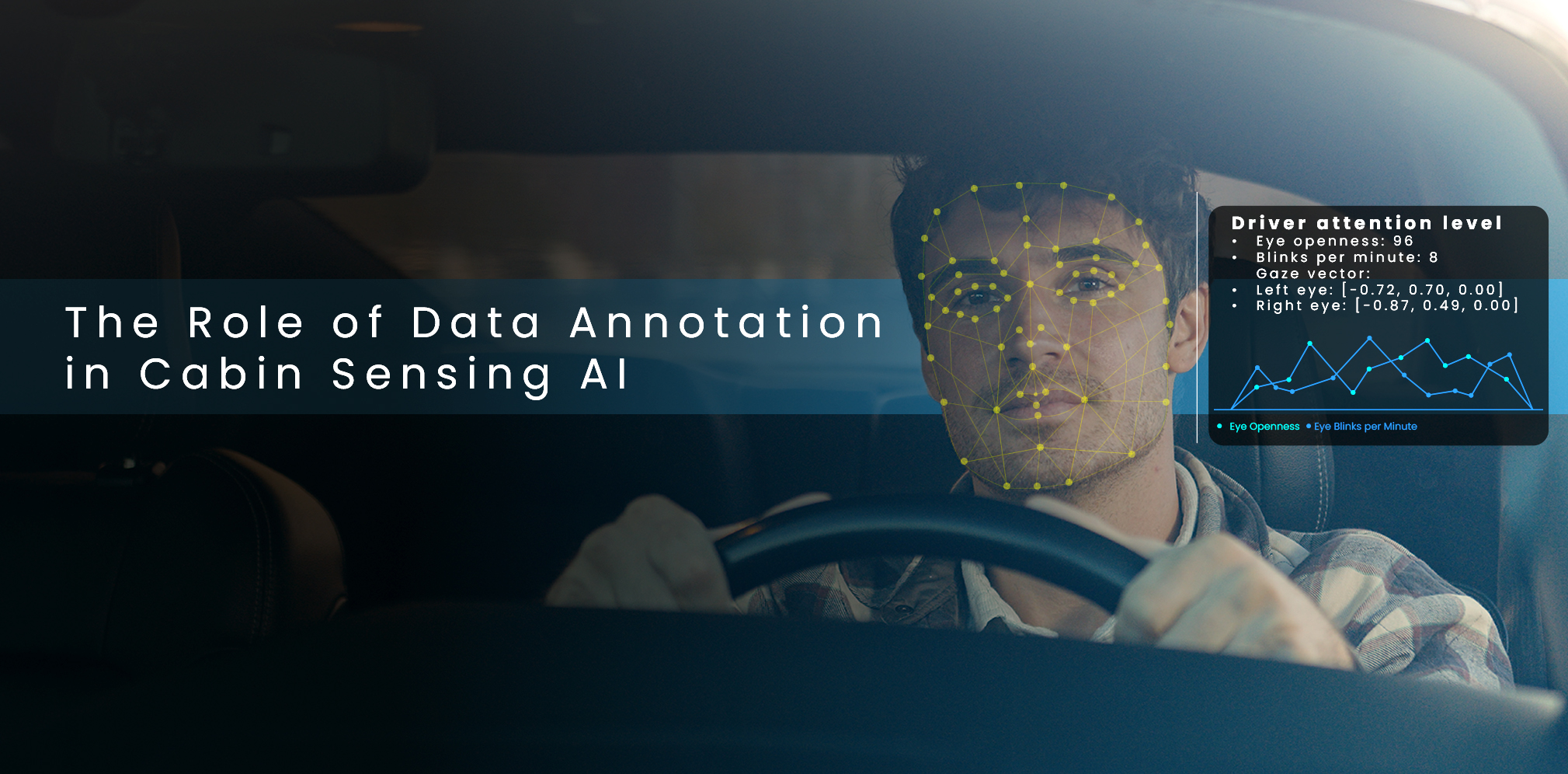
Cabin sensing systems use in-vehicle cameras and other sensors to detect driver attention, occupant presence and relevant activity inside a vehicle. Their performance depends not only on sensors and AI models but also on the data annotation used to train and validate those models. Consistent labels help computer vision systems distinguish everyday actions from potential safety risks, such as a routine mirror check versus prolonged attention away from the road.
For automotive OEMs, Tier 1 suppliers and AI development teams, cabin data presents a particular challenge: the same gesture can have different meanings depending on duration, gaze, posture and driving context. This article explains how high-quality image annotation, video annotation and human review support reliable driver and occupant monitoring, while preserving a practical focus on annotation quality and safety.
Quick Overview
Data annotation converts raw in-cabin images, video and relevant sensor signals into labeled examples for AI training and evaluation. It supports driver drowsiness detection, distraction recognition and occupant monitoring, but requires careful handling of ambiguous behavior, difficult lighting, occlusion, human variability and sensitive personal data. Human-in-the-Loop (HITL) review is particularly valuable where model-generated labels are uncertain or the consequences of mistakes are significant.
What Are Cabin Sensing Systems and How Do They Work?
Cabin sensing systems observe conditions within a vehicle rather than the road outside. Depending on the vehicle design, inputs can include infrared or RGB cameras, depth cameras, radar and other sensors. A driver monitoring system may estimate eye closure, gaze direction and head position; an occupant monitoring system may identify seat occupancy or occupant movement. Not every implementation uses every sensing modality.
During development, teams collect representative data, define labeling rules, annotate selected events, review the labels and train or evaluate detection models. In a deployed vehicle, the trained model analyzes incoming sensor information and may support a warning or another designed response. Annotation typically happens during dataset preparation and improvement, not at the instant a production warning is generated.
This distinction matters because clean training labels are necessary but not sufficient for a dependable safety feature. Vehicle-specific integration, model validation and system testing remain essential.
Why Data Annotation Is the Cornerstone of Cabin Sensing AI
Data annotation assigns meaningful labels to the evidence a system must learn from: faces, head pose, eyelid state, gaze direction, gestures, seat occupancy and behavior over time. It supplies the reference information used to train machine learning models and to measure whether their predictions match carefully reviewed examples.
A single image showing a downward head tilt may not reveal whether a driver is checking the dashboard, looking at a phone or becoming drowsy. Video context and consistent event definitions can help reviewers decide how an example should be labeled. If superficially similar behaviors receive inconsistent tags, the model may learn unreliable boundaries between ordinary and safety-relevant activity.
The same principle applies to occupants. Seat interaction, posture changes and partial visibility need clear definitions so the training dataset represents real cabin conditions. Accurate labels help build the foundation for computer vision, but validation must still test model behavior on varied, independent data.
Types of Data Annotation Used in Cabin Sensing Systems
Bounding Boxes and Image Annotation
Bounding boxes indicate the location of a driver, occupant, face or relevant object within a frame. Image annotation may also mark occlusion or visible accessories that affect detection, such as sunglasses. A consistent bounding-box policy is important when a face is partly hidden or a person moves between seats.
Keypoint and Landmark Annotation
Keypoints can mark facial landmarks, eye corners or other positions used to estimate head pose and gaze. Annotators need explicit guidance for partly visible landmarks, left-right consistency and cases in which reliable points cannot be assigned. Such labels can support driver attention models but do not by themselves prove what a driver is thinking or feeling.
Video Annotation and Temporal Events
Video annotation follows activities across frames, helping models learn the difference between a brief glance and sustained distraction. Time-based labels can identify the beginning and end of an action, while tracking keeps a person or object consistently identified through a sequence. Reviewers should use agreed event boundaries and handle overlapping actions consistently.
Segmentation and Sensor Data Annotation
Segmentation can delineate pixel-level regions when fine boundaries are needed. For multimodal projects, sensor data annotation may align camera observations with relevant time-stamped radar or depth measurements. Reliable synchronization and a shared labeling definition are important; data fusion should be included only when the system actually uses more than one modality.
How Data Annotation Supports Driver and Occupant Monitoring
Driver Drowsiness and Fatigue Detection
Driver drowsiness detection models may learn from labeled eye closure, blinking patterns, head movement or other observable cues. A driver fatigue detection system needs representative examples under varying lighting, camera angles and driver appearances. Labels should distinguish observable behaviors from inferred medical or emotional states, and test sets should include challenging but plausible examples.
Driver Distraction Detection
Driver distraction detection depends on context and duration. Looking toward a side mirror may be appropriate driving behavior, whereas prolonged attention to a handheld phone can be a relevant distraction pattern. Annotated sequences can capture gaze direction, hand-to-object interactions and time windows, making the task more informative than assigning a single label to a still image.
Occupant Detection and Behavior Recognition
Cabin systems may need to distinguish occupied and unoccupied seats, recognize posture changes or identify movement among multiple passengers. Annotation becomes difficult when passengers overlap, wear bulky clothing or are only partly visible. Carefully labeled sequences and clearly defined uncertainty categories help evaluation teams examine those situations without overstating detection capability.
The High-Stakes Challenges of Data Annotation in Cabin AI
Real cabin footage varies considerably. Annotation guidelines should be tested against people of different sizes, appearances and postures, with variations in clothing, lighting and camera position. Low-light infrared imagery may look different from daytime RGB footage, while glasses, face coverings, seat geometry and hands can obscure important features.
Context also changes the meaning of a label. A downward glance might be routine, while repeated or sustained gaze away from the road could warrant a different event tag. Ambiguous examples require a documented decision rule and an option to escalate rather than a forced label. Other common issues include inconsistent frame timestamps, annotation drift between reviewers, class imbalance and rare edge cases.
For safety-relevant applications, quality is better described through audited label consistency, coverage and error analysis than through a single broad accuracy promise. Evaluating false alarms and missed detections on representative model test sets is a separate, essential task.
Beyond Automation: Why Cabin Sensing Needs Human-in-the-Loop
Human-in-the-Loop annotation combines AI-assisted labeling with specialist review. Pre-labeling can help prepare bounding boxes, object tracks or candidate event intervals; reviewers then correct uncertain outputs and examine conditions where automation performs less consistently. The purpose is to keep the annotation process efficient without treating a machine-generated suggestion as ground truth.
A practical workflow includes five connected stages: dataset sampling and task guidelines; initial labeling or AI-assisted pre-labeling; specialist review of uncertain or high-risk cases; quality auditing and correction; and feedback into guidelines and subsequent annotation cycles. Projects may also measure inter-annotator agreement and conduct targeted reviews of rare behaviors.
Human judgment is particularly important for distinguishing a mirror glance from phone use, investigating heavy occlusion and resolving event timing. Reviewers still need rigorous written standards: human review without calibrated definitions can introduce its own inconsistency. NextWealth describes a HITL approach to annotation on its published service pages, combining trained review with computer vision labeling workflows.
Data Privacy and Security in Cabin Sensing Annotation
In-cabin datasets may show faces, passengers and behavior in a private space. Data collection and annotation therefore require privacy-aware design, particularly when footage can identify individuals. Organizations should establish a lawful basis for processing, limit collection and retention to the project need, and control access to sensitive content according to the applicable rules and agreements.
Where practical, teams can use de-identification, restricted viewing environments, documented permissions and separation of identifying information from annotation outputs. The right approach depends on whether identity itself is necessary for the labeling task. Security controls protect the dataset; they do not replace accuracy checks or model fairness evaluation.
From Mandate to Market: The Global Future of Cabin Sensing
Driver monitoring has gained attention as vehicle safety rules and consumer safety assessments place greater emphasis on driver attention and distraction. In the European Union, the General Safety Regulation introduced staged requirements for certain driver-warning technologies. Requirements differ by function, vehicle type and applicability date, so they should be checked against current official legislation rather than condensed into a blanket claim that every cabin sensing capability is mandatory.
In the United States, research and policy discussion have included impaired-driving prevention and driver monitoring, but proposals, research activity and binding vehicle requirements are not interchangeable. For engineering teams, these developments reinforce the need for traceable annotation specifications, repeatable quality review and model evaluation suited to the target use case.
Technical progress also raises data requirements. More cabin configurations, infrared and visible-light streams, diverse occupants and difficult edge cases increase the value of consistent datasets. Better sensors cannot compensate for labels that are poorly defined or applied inconsistently.
NextWealth’s Approach to Data Annotation in Cabin Sensing Systems
NextWealth positions its data annotation and computer vision services around image and video labeling, quality review and Human-in-the-Loop processes. Its published service portfolio includes bounding boxes, keypoints, segmentation and video annotation capabilities that can be relevant to cabin sensing development. The exact workflow, review levels, data format and acceptance criteria should be established for each customer program.
For an automotive team, that means starting with the annotation ontology: what constitutes eye closure, a phone interaction, an occluded occupant or an uncertain gaze label? Next come sample reviews, exception routing and measurable quality gates. An appropriate delivery plan should also consider the handling of sensitive in-cabin imagery and the range of driving scenarios represented in the dataset.
Teams seeking support for this work can review NextWealth’s computer vision annotation and data annotation services to determine whether the supported methods match their model objectives.
Case Study: Cabin Sensing Annotation at Scale
NextWealth’s existing article describes an engagement for a Tier 1 automotive software provider that needed high-volume annotation of driver and occupant behavior under changing cabin conditions. The stated challenge involved facial expressions, fatigue and distraction labels, and the need for contextual consistency across many video frames.
According to the existing article, the project used a HITL-driven pipeline, specialist preparation and multi-stage quality checks to review complex sequences. It reports 98%+ annotation accuracy and processing of tens of thousands of frames daily. These are company-reported figures and should be confirmed against approved case-study evidence, the metric definition and the measurement period before external republication.
The broader lesson is the value of pairing annotation throughput with clear event definitions, calibrated reviewers and an auditable correction process. That operational discipline is relevant to both initial model training and later dataset updates.
Conclusion:
The role of data annotation in advancing cabin sensing systems is to turn complex in-cabin observations into reliable, reviewable training and evaluation examples. Image annotation, video annotation and sensor-aligned labeling support distinct monitoring tasks, from detecting potential drowsiness to understanding occupant presence and driver attention.
AI-assisted workflows can reduce repetitive effort, but context-sensitive cases require trained review and transparent quality rules. For automotive developers, the priority is not simply more labeled frames: it is representative data, consistent labels, documented uncertainty and validation that reflects real conditions. NextWealth’s HITL-oriented annotation services can form part of that process when aligned with the specific requirements of the vehicle program.
Final Call to Action:
If you’re building the future of cabin sensing, partner with NextWealth. Together, we’ll ensure your AI systems are trained on the kind of data that regulators trust, automakers demand, and passengers deserve.
Frequently Asked Questions
What is data annotation in cabin sensing systems?
It is the process of labeling in-cabin images, video and relevant sensor observations so AI models can learn to identify defined events or features. Examples include face locations, eye closure, head pose, occupant positions and time-stamped actions. The labels are used in model training and evaluation.
2. How does data annotation support driver monitoring systems?
Annotated examples help a driver monitoring model recognize visual patterns associated with attention, eye closure, gaze and other defined behaviors. Consistent labels help distinguish similar-looking actions and support evaluation on varied conditions. Training data quality is important, although reliable deployment also requires vehicle-level validation.
3. Which annotation techniques are used for cabin sensing?
Common techniques include bounding boxes for people or objects, keypoints for facial landmarks, video tracking and temporal event tags for actions over time. Segmentation and synchronized sensor data annotation may also be used when a project requires finer regions or multiple sensing modalities.
4. Why is video annotation important for driver fatigue detection?
Video preserves the timing and sequence of observable behavior. Annotators can label eye closure intervals, gaze changes or sustained head movement across frames rather than infer an event from a single photograph. Event definitions, sampling rules and timestamp accuracy all affect the usefulness of these labels.
5. What is the role of Human-in-the-Loop review?
HITL review lets trained specialists check AI-assisted labels, resolve ambiguous activities, correct boundaries and document exceptions. It is useful when faces are occluded, behavior is context-dependent or initial predictions are uncertain. The review process should follow agreed guidelines and independent quality checks.
6. What makes in-cabin sensor data difficult to annotate?
Challenges include glare, low light, camera placement, sunglasses, overlapping occupants, varying posture and events with unclear start or end times. Multimodal datasets add synchronization issues. Strong annotation guidance, diverse samples and calibrated review procedures help teams manage these sources of inconsistency.