
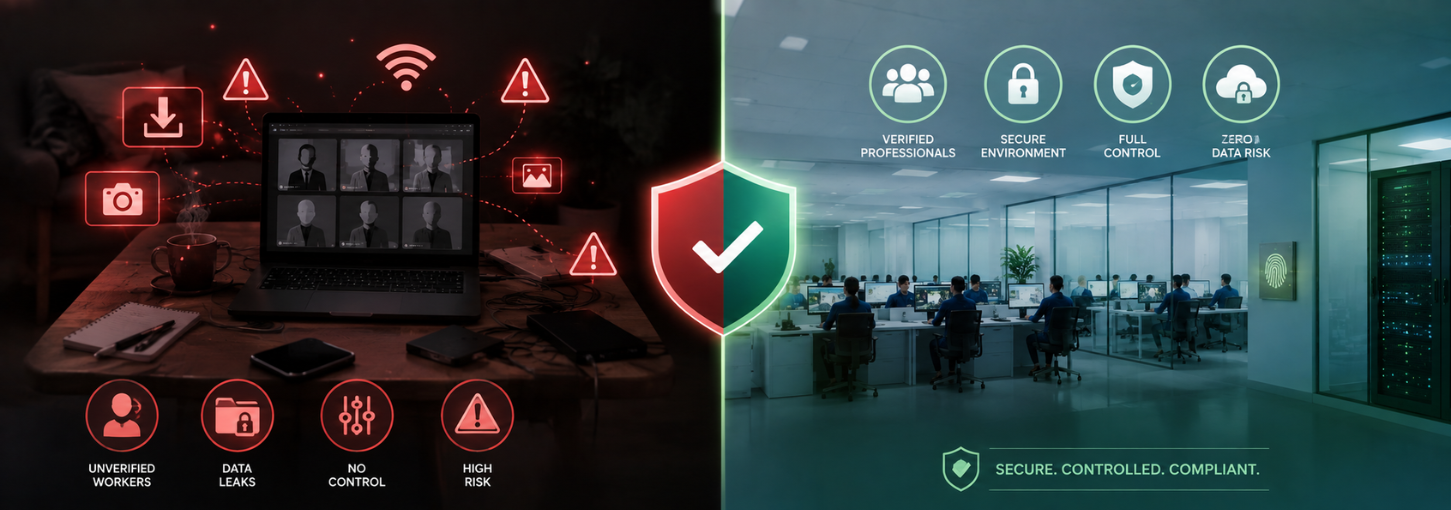
Picture this: Your engineering team spends $10 million hardening your cloud perimeter, installing military-grade encryption, and enforcing Zero-Trust access controls. Your AI model is state-of-the-art, trained on proprietary trade secrets. But while your front door is locked like Fort Knox, your back door is wide open.
Where is that back door? In the unvetted, anonymous crowd-workers labeling your data on unencrypted home Wi-Fi networks across the globe.
As global AI regulations tighten under strict enforcement frameworks like the EU AI Act and NIST AI RMF, enterprise buyers are experiencing a massive mindset shift. Data annotation is no longer viewed as a cheap commodity task, it is recognized as a major compliance risk and cybersecurity threat vector.
| What is the biggest security risk in AI data annotation?The primary risk in AI data annotation is using anonymous crowdsourced labor, which leads to PII data leaks, intellectual property theft, and adversarial dataset poisoning. Modern enterprise AI security requires transitioning from open crowd networks to secure, managed Human-in-the-Loop (HITL) operations featuring air-gapped delivery centers, zero-retention in-cloud pipelines, and 100% background-checked, contractually bound teams. |
The Nightmares Keeping Enterprise CISOs Awake at Night
When enterprises rely on open crowdsourcing platforms to process complex datasets, they inherit two devastating vulnerabilities:
- 1. The Invisible Leak (PII & IP Theft): Gig workers download raw datasets onto personal laptops connected to home routers. Without clean-room restrictions, sensitive medical records (HIPAA), financial trade secrets (PCI-DSS), or user telemetry can easily be screenshotted, cached, or leaked into public generative AI models.
- 2. Adversarial Data Poisoning: Anonymous, high-turnover annotators lack accountability. A single rogue worker or compromised node can subtly mislabel or tamper with training data, injecting backdoors or critical bias into your AI model before it reaches production.
| Market Intelligence Snapshot:According to Gartner research, by 2027, over 40% of AI-related data breaches in large enterprises will originate from cross-border workforce misuse and inadequate data privacy oversight within generative AI and machine learning development pipelines.Source: Gartner Research, Operationalizing AI Trust, Risk & Security Management (AI TRiSM) Framework. |
Building the AI Fortress: The Three Pillars of Secure AI Operations
To mitigate these risks, industry leaders are turning to Secure Human-in-the-Loop (HITL) Operations. Instead of sending data into an unverified crowd void, secure operations rely on three foundational pillars:
Pillar 1: Physical & Infrastructure Security (Air-Gapped Delivery Centers)
Security starts on the ground. Dedicated Objective Delivery Centers (ODCs), frequently hosted in thriving tech hubs (Tier-2 cities) operate like clean rooms. Workstations are air-gapped with no USB access, biometric doors restrict entry, and personal mobile phones or recording devices are strictly banned from screens displaying sensitive client data.
Pillar 2: Data Transmission & Privacy (Zero-Retention Pipelines)
Why transfer raw files when you don’t have to? Modern data labeling operates directly within the client’s secure cloud environment via encrypted streaming. Annotators label data in real time with zero local persistence or cached files, guaranteeing strict compliance with SOC 2, ISO 27001, GDPR, and HIPAA standards.
Pillar 3: The Anti-Crowd Workforce Advantage
Anonymous crowd-workers are an enterprise vulnerability. Secure AI operations leverage a 100% verified, in-house, background-checked workforce bound by comprehensive non-disclosure agreements (NDAs) and rigorous data governance training.
Enterprise AI Vendor Evaluation Matrix
Use this decision matrix when evaluating AI data partners against modern compliance and security standards:
| Security Baseline | Traditional Crowdsourcing | NextWealth Secure AI Ops |
| Workforce Verification | Anonymous gig workers | 100% background-checked, full-time employees |
| Physical Clean-Rooms | Unsecured home Wi-Fi & laptops | Biometric access ODCs & air-gapped terminals |
| Data Storage Model | Local downloads & temporary caching | Zero-retention, in-client cloud streaming |
| Compliance Standards | Variable self-assessments | Audit-ready SOC 2, ISO, HIPAA & GDPR pipelines |
| Data Poisoning Defense | Vulnerable to transient rogue actors | Managed, audited workflows with full traceability |
Conclusion: Data Annotation is Infrastructure, Not an Afterthought
As AI evolves from experimental novelties into core business drivers, your data supply chain deserves the same ironclad protection as your primary cloud servers. Partnering with dedicated, secure AI operations specialists like NextWealth ensures your machine learning models scale rapidly without exposing your enterprise to catastrophic data breaches or regulatory penalties.
Frequently Asked Questions
Q: Why is crowdsourced data labeling risky for enterprise AI?
A: Crowdsourced labeling relies on anonymous gig workers downloading sensitive data onto personal, unencrypted devices over public home Wi-Fi networks. This exposes enterprises to PII leaks, IP theft, regulatory non-compliance, and adversarial data poisoning.
Q: What is a Zero-Retention pipeline in AI data labeling?
A: A Zero-Retention pipeline allows human annotators to stream and label data directly inside the client’s secure cloud environment without saving, caching, or storing any raw data files locally.