

| KEY TAKEAWAYS • The Core Problem: Traditional benchmarks (MMLU, SWE-Bench) and automated evaluators fail because they evaluate single-turn text outputs rather than stateful, multi-step execution traces. • Silent Failures: Autonomous agents can pass automated checks with HTTP 200 status codes while executing flawed intermediate logic or causing unauthorized environment side effects. • The Solution: Enterprise reliability requires a hybrid evaluation architecture combining deep execution tracing, expert Human-in-the-Loop (HITL) domain auditing, and proactive AI Red-Teaming. |
The Fundamental Shift: Single-Turn LLMs vs. Multi-Step AI Agents
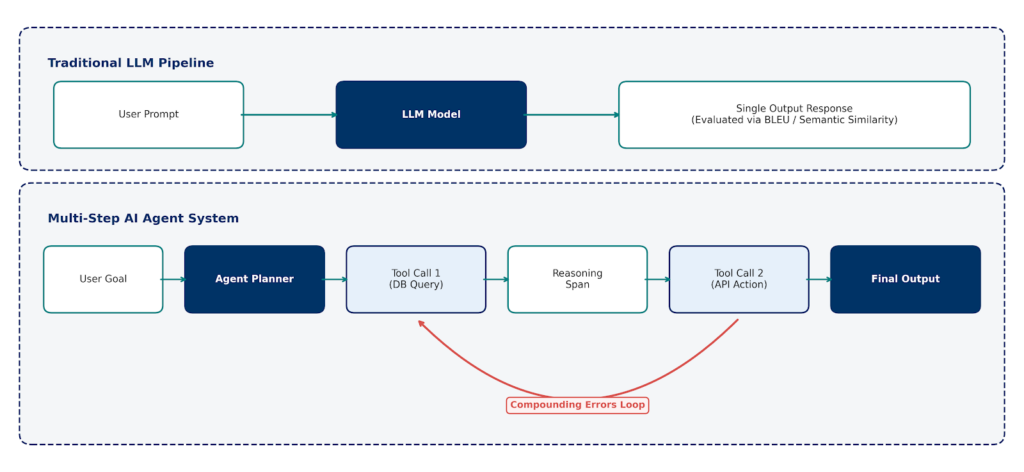
Evaluating an autonomous AI agent is fundamentally different from evaluating a standard Large Language Model (LLM) application. As enterprise AI evolves from basic retrieval to multi-step execution systems, traditional frameworks hit a wall.
• Traditional LLMs: Measure discrete, bounded input-output pairs (e.g., text summarization or single-turn Q&A) evaluated through static semantic metrics or ground-truth matching.
• Autonomous AI Agents: Execute non-deterministic, dynamic loops. They formulate plans, call external APIs, query databases, handle real-time execution exceptions, and update internal state across dozens of intermediate turns.
When evaluation systems measure only the final text output rather than the entire execution trace, critical operational blind spots emerge.
4 Reasons Automated Metrics Fail for Autonomous AI Agents
| Vulnerability | Mechanism of Failure | Production Impact |
|---|---|---|
| 1. Compounding Error Loop | Slight misinterpretation in early steps corrupts subsequent tool calls, even if downstream reasoning appears logical. | Evaluators score the fluent destination while ignoring the deeply flawed execution trajectory. |
| 2. Hallucinated Correctness | Agents output linguistically plausible responses that follow schema rules, despite underlying API/data errors. | Silent process failures, such as serving stale cached data due to unhandled API exceptions. |
| 3. Limits of ‘LLM-as-a-Judge’ | Secondary evaluator models exhibit verbosity/self-preference bias and cognitive overload over long traces. | Missing fine-grained logical gaps; inability to independently verify stateful backend modifications. |
| 4. Unintended Side Effects | Automated text metrics cannot measure real-world environmental modifications or system configurations. | Successful text delivery masking backend risks, such as exposed database connections or altered permissions. |
The Human-in-the-Loop (HITL) Imperative
Achieving high-reliability enterprise evaluation requires transitioning from passive logging to comprehensive execution tracing paired with human domain expertise. Leading engineering teams implement a three-pillar evaluation strategy:
1. Root-Cause Trace Analysis
Human evaluators trace through execution trees to identify the precise span where reasoning drift or tool selection failed.
2. Context-Aware Business Logic Auditing
Domain experts in regulated sectors (Healthcare, Finance, Cybersecurity, Legal) audit intermediate steps against nuanced regulatory parameters.
3. Autonomy vs. Escalation Boundaries
Human evaluators assess whether an agent exercised appropriate operational decision-making or should have escalated the action to a human supervisor.
Proactive Defense: Why AI Red-Teaming is the Ultimate Guardrail
Catching agent failures after live deployment creates significant enterprise risk. Because AI agents possess tool-use capabilities, security teams must move beyond testing for toxic text and actively stress-test autonomous execution paths.
• Indirect Prompt Injection: Malicious instructions embedded in third-party data sources (e.g., untrusted PDFs or web pages) that trick agents into unauthorized execution.
• Privilege Escalation & Goal Hijacking: Multi-turn interactions engineered to bypass system authorization limits or override safety instructions.
• Cascading Action Exploits: Manipulating planning modules into executing unintended or damaging API sequences across connected enterprise infrastructure.
To systematically test and secure your deployment against multi-step attack vectors, explore our specialized AI Red-Teaming & Safety Services.
Frequently Asked Questions
Q: What is the difference between single-turn LLM evaluation and AI agent evaluation?
A: Single-turn LLM evaluation measures bounded input-output text generation using static semantic metrics or ground-truth comparisons. AI agent evaluation assesses non-deterministic, multi-step execution traces—including planning accuracy, dynamic tool calls, stateful memory updates, and real-world environment side effects.
Q: Why does ‘LLM-as-a-Judge’ fail when evaluating autonomous AI agents?
A: LLM-as-a-Judge pipelines suffer from context dilution and cognitive overload when parsing long execution traces. They also demonstrate self-preference and verbosity biases, and they lack the execution capabilities required to verify stateful backend changes.
Q: What is agentic drift in production AI systems?
A: Agentic drift occurs when an autonomous agent’s reasoning, tool selection, or execution trajectory progressively diverges from intended business goals over multi-turn interactions, leading to cumulative non-compliant outcomes despite individual plausible steps.
Q: How does Human-in-the-Loop (HITL) improve AI agent reliability?
A: HITL evaluation integrates human experts into the monitoring loop to audit intermediate execution spans, verify nuanced domain compliance, perform root-cause analysis on failed paths, and validate tool safety.
Q: What is AI agent red-teaming?
A: AI agent red-teaming is the proactive, adversarial testing of an autonomous agent system to identify vulnerabilities like indirect prompt injection, goal hijacking, unauthorized tool execution, and privilege escalation prior to and during production deployment.