
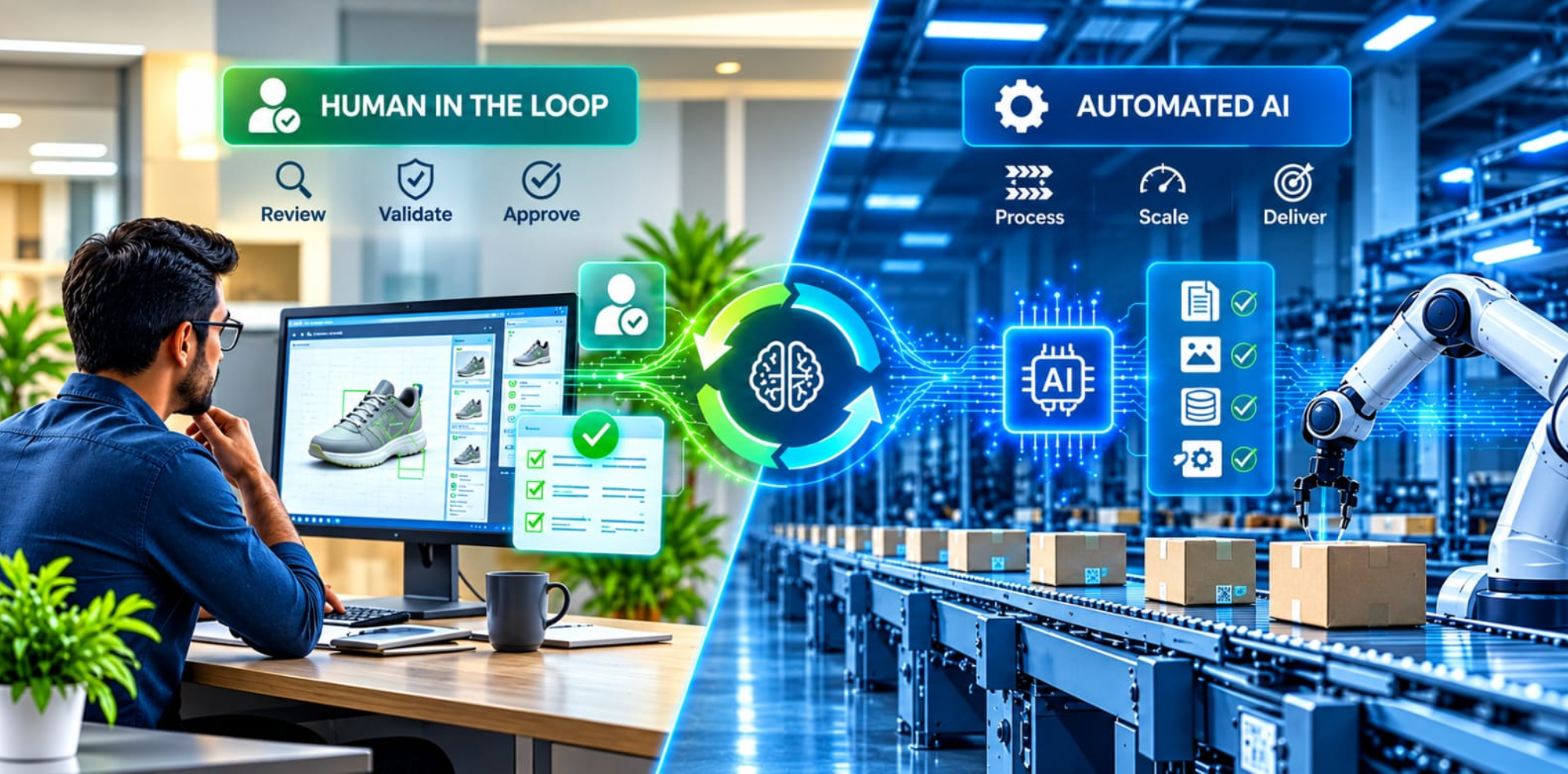
| Executive Summary : Human-in-the-Loop AI and fully automated AI are not competing approaches. The right choice depends on the risk, complexity, and impact of each workflow. Low-risk, repeatable tasks can often run efficiently with full automation, while high-stakes, regulated, or irreversible decisions require structured human oversight. This article explains how enterprises can combine both models effectively using risk-based segmentation, confidence-based routing, traceable approvals, and trained human reviewers. The goal is to scale AI without creating unnecessary bottlenecks or compromising accountability, accuracy, and compliance. |
Human-in-the-Loop AI vs Automated AI: Why Enterprises Need Both
The debate around human-in-the-loop AI versus automated AI is not a matter of preference or risk tolerance. It is a matter of workflow design. Enterprises that apply the same oversight model across every AI-driven process will either create unnecessary bottlenecks or expose critical decisions to unacceptable risk.
The correct approach is to assign human review in AI workflows where it changes the outcome and remove it where it does not. This blog outlines how both models work, where each belongs in an enterprise AI stack, and what a structured human in the loop process looks like at scale.
What Human-in-the-Loop AI Means in Practice
Human-in-the-loop AI (HITL AI) is a system design approach where human review is a required step inside the workflow, not an optional check outside it. The AI processes an input, reaches a defined decision point, and the workflow cannot advance until a qualified human reviews and authorizes the output.
This is architecturally different from making a reviewer available. In systems where humans can check outputs if they choose to, oversight is informal and unenforceable. In a properly configured HITL system, human approval in AI pipelines is captured in an auditable record: who reviewed, under what context, and when the decision was made.
The EU AI Act (Article 14) and the NIST AI Risk Management Framework both require demonstrable human control in AI decision making for high-risk AI categories. Documented, traceable, role-specific authorization satisfies those standards. Informal reviewer availability does not.
Four operating patterns are used in production HITL deployments:
- Full review. Every AI output goes to a human before execution. Used in domains where error rates are unvalidated at scale or where decisions carry significant legal or financial exposure.
- Confidence-based routing. High-confidence outputs run automatically. Low-confidence outputs are routed for human approval in AI pipelines. The most common pattern in enterprise deployments today.
- Category-mandatory review. All outputs in defined categories receive human review regardless of confidence score. Applied to regulated decisions, high-value transactions, and scenarios outside the model’s validated training distribution.
- AI-assisted human decision. The human makes the primary decision with AI providing supporting data, ranked options, and retrieved context. Used where stakes are highest and the model functions as a decision support layer only.
Where Fully Automated AI Is the Right Choice
Adding a human-in-the-loop checkpoint to a low-risk, high-volume workflow with a validated error rate does not improve governance. It creates operational friction. Fully automated AI is the correct configuration when human review adds no meaningful difference to the outcome.
Workflows suited to full automation share consistent characteristics: the task structure is stable, the error rate has been measured at production scale, individual errors are low-cost and correctable, and no regulation mandates per-decision human authorization.
Common candidates:
- Document routing and classification on stable, predictable schemas
- Duplicate detection across large data pipelines
- Pre-screening queues that surface only uncertain cases for human review in AI workflows
- Standard categorization tasks where output accuracy has been validated at scale
- Routine AI training data annotation for well-scoped labeling tasks with high model confidence
Enterprises that restructure pipelines around this split have achieved cost reductions exceeding 90% while improving output accuracy from the low seventies into the mid to high nineties. The gains come from correct allocation, not from choosing one model over the other.
Where Enterprise Deployments Go Wrong
Uniform HITL and uniform automation are both the wrong answer. Applying human oversight of AI systems across every output regardless of risk creates a volume problem. Reviewers face approval queues that cannot be scrutinized at pace. The governance record reflects oversight. The decisions are still effectively made by the AI.
This is automation bias in AI systems: the governance structure is in place but the human judgment inside it has been replaced by habitual approval. It is one of the most documented failure modes in enterprise AI deployments and one of the hardest to detect because the audit trail looks correct.
The opposite error, removing human review in AI decision making from regulated or high-stakes workflows, creates a different category of exposure. AI agents that modify records, process approvals, or take actions with downstream consequences leave no trail of AI decision accountability when something fails. Auditors and regulators cannot be shown oversight that was never built into the process.
Three questions determine the correct configuration for any workflow:
- Is the decision reversible if the AI output is incorrect?
- Does a regulatory framework require documented human authorization for this category of decision?
- Does legal or financial liability depend on a traceable human action in the approval record?
An affirmative answer to any of these means the workflow requires a human in the loop checkpoint. A negative answer across all three, combined with a validated error rate, means full automation is the appropriate configuration.
Building an AI Governance Framework That Scales
According to Gartner, 40% of enterprise applications will include task-specific AI agents by the end of 2026, up from less than 5% in 2025. As deployment scales at that rate, the gap between what AI systems are executing and what humans are actually authorizing grows in direct proportion. Responsible AI deployment at that scale requires more than HITL configuration. It requires a governance structure with four components.
Risk-tier segmentation
Every AI-driven process is mapped to a tier based on reversibility, regulatory exposure, and downstream liability. Tier assignment determines the AI workflow human oversight configuration. It is a governance decision, not an operational preference, and it should be made before deployment rather than revised after a failure.
Traceable approvals
A governance record that captures who authorized a decision, with what context, and at what time is what regulators and auditors require. Binding agent actions to authenticated, logged approvals is what converts a review step into enforceable enterprise AI compliance. An unsigned approval log is not HITL. It is the appearance of HITL.
Confidence-based routing
Routing only low-confidence or high-risk cases to human reviewers is how AI quality assurance with human review stays operationally viable as AI volumes scale. Production HITL systems that send every output to a human reviewer become bottlenecks. Systems that route selectively maintain governance without degrading throughput. This is the operational basis for AI human collaboration at enterprise scale.
Reviewer capability, not just reviewer assignment
Assigning a reviewer and building that reviewer’s capacity to evaluate outputs effectively are not the same thing. Reviewers who lack training on what to look for, when to escalate, and how to recognize automation bias in AI systems in their own behavior will approve outputs without genuine scrutiny. The governance record appears complete. The functional oversight is absent. This is the gap that turns formal HITL into a compliance exercise rather than an operational one.
The Business Case
Enterprise AI is no longer in the pilot phase. According to PwC’s 2025 AI Agent Survey of 308 senior US executives, 79% report their organizations are already deploying AI agents and 66% report measurable productivity gains. AI governance for enterprises is the differentiator that determines whether production deployment creates durable value or accumulated operational risk.
The accuracy case follows the same logic. Structured human in the loop training data pipelines consistently outperform fully automated baselines. Clients in production HITL workflows report annotation accuracy improvements of 20 to 35% over automated baselines. AI model accuracy improvements of up to 40% are reported within two retraining cycles. Those gains are not achieved by model improvements alone.
The organizations that lead the next phase of enterprise AI are not the ones automating the most decisions. They are the ones that have determined precisely where automation should run unattended and where human review in AI decision making is the mechanism that makes the system trustworthy enough to scale.
FAQs
What is human-in-the-loop AI?
Human-in-the-loop AI is a system design approach where human review is embedded into AI workflows at defined decision points. The process cannot advance until a human approves the output. Human approval in AI pipelines is an architectural requirement, not an informal check.
What is the difference between human-in-the-loop AI and fully automated AI?
In automated AI, the system executes end to end without requiring human input. In human-in-the-loop AI, a human must review or authorize output at defined checkpoints before the process continues. The correct configuration depends on the specific workflow, its regulatory context, and the reversibility of its outputs. Neither model is universally correct.
Which AI workflows require human review?
Workflows where decisions are irreversible, where regulations mandate documented human authorization, or where legal or financial liability depends on a traceable human action. High-value financial decisions, healthcare AI outputs used in clinical settings, AI content moderation for high-risk categories, and AI agent actions that modify records or system states are common examples.
Can AI operate fully automated without compliance risk?
In appropriate workflows, yes. If a decision is reversible, no regulation mandates human sign-off on AI decisions per transaction, and the accuracy rate has been validated at scale, full automation is defensible. Duplicate detection, standard classification, pre-screening pipelines, and routine AI data labeling tasks are common candidates.
What is automation bias and why does it matter?
Automation bias in AI systems occurs when reviewers approve AI outputs without genuine scrutiny because the system appears reliable and review volume is high. The governance record reflects oversight. The decisions are still effectively made by the AI. Preventing it requires concentrating human review on genuinely uncertain or high-risk outputs and ensuring reviewers are trained on evaluation criteria, not just process steps.
How does the EU AI Act affect human oversight requirements?
Article 14 of the EU AI Act requires that high-risk AI systems include meaningful human control in AI decision making: oversight that is trained, measurable, and provable. Organizations must demonstrate that designated humans had the authority, the context, and the tools to review and override decisions at defined points. Full implementation for high-risk AI categories applies from August 2026.
How do I assess whether my AI workflows have the correct level of oversight?
Evaluate each workflow against three criteria: Is the decision reversible? Does a regulation require human approval in AI pipelines? Does liability depend on a traceable human approval record? A yes to any of these indicates the need for a HITL checkpoint. Beyond configuration, assess whether reviewers are genuinely evaluating outputs. High approval rates at high volumes are a signal of automation bias rather than functional governance.