
Quick Overview: Why 3D Cuboid Annotation is Crucial for AI
This guide explores the transformative role of 3D cuboid annotation in enhancing AI’s spatial understanding. It emphasizes how transitioning from 2D to 3D annotation improves model accuracy by capturing depth, orientation, and context, making AI more aware of its environment. For businesses seeking advanced computer vision solutions, understanding 3D cuboid annotation services is key to unlocking next-generation AI capabilities.
Key points include:
- The role of 3D cuboid annotation in bridging the gap between 2D recognition and 3D spatial awareness.
- How human-in-the-loop (HITL) data annotation ensures precision in complex scenarios.
- The impact of cuboid annotation services on AI scalability and real-time decision-making.
- Anatomy of an effective annotation process: Combining automation with human oversight.
- Use Cases: Applications of 3D cuboid annotation in industries like autonomous vehicles, robotics, and augmented reality.
Introduction: The Evolution of AI Vision with 3D Cuboid Annotation
In the rapidly evolving domain of artificial intelligence (AI), visual understanding is entering a new dimension. Traditional computer vision systems have long relied on 2D bounding boxes to identify and locate objects in imagery. However, these approaches struggle to capture the richness of our 3D world. Today, industries across autonomous mobility, robotics, retail automation, and augmented reality are looking beyond flat images. They seek spatially aware AI that can perceive depth, orientation, and context. At the heart of this transformation lies 3D cuboid annotation services.
Rethinking Spatial Awareness in Computer Vision: Beyond 2D
Most computer vision models trained on 2D data recognize objects well but fall short in real-world interaction. Consider a retail robot navigating an aisle or an autonomous vehicle merging into traffic. These systems require more than just object presence; they demand an understanding of distance, direction, and spatial relationships. This is where 3D cuboid annotation becomes indispensable.
3D cuboid annotation helps bridge this gap. By representing objects in volumetric form, it adds a third dimension to vision AI, turning recognition into actionable understanding. This is especially important in environments with occlusion, overlapping objects, or motion dynamics, where 2D cues alone are insufficient. While 2D annotation still has its place, 3D annotation is far more effective in capturing real-world complexity and enabling advanced computer vision depth.
What is 3D Cuboid Annotation and How Does it Work?
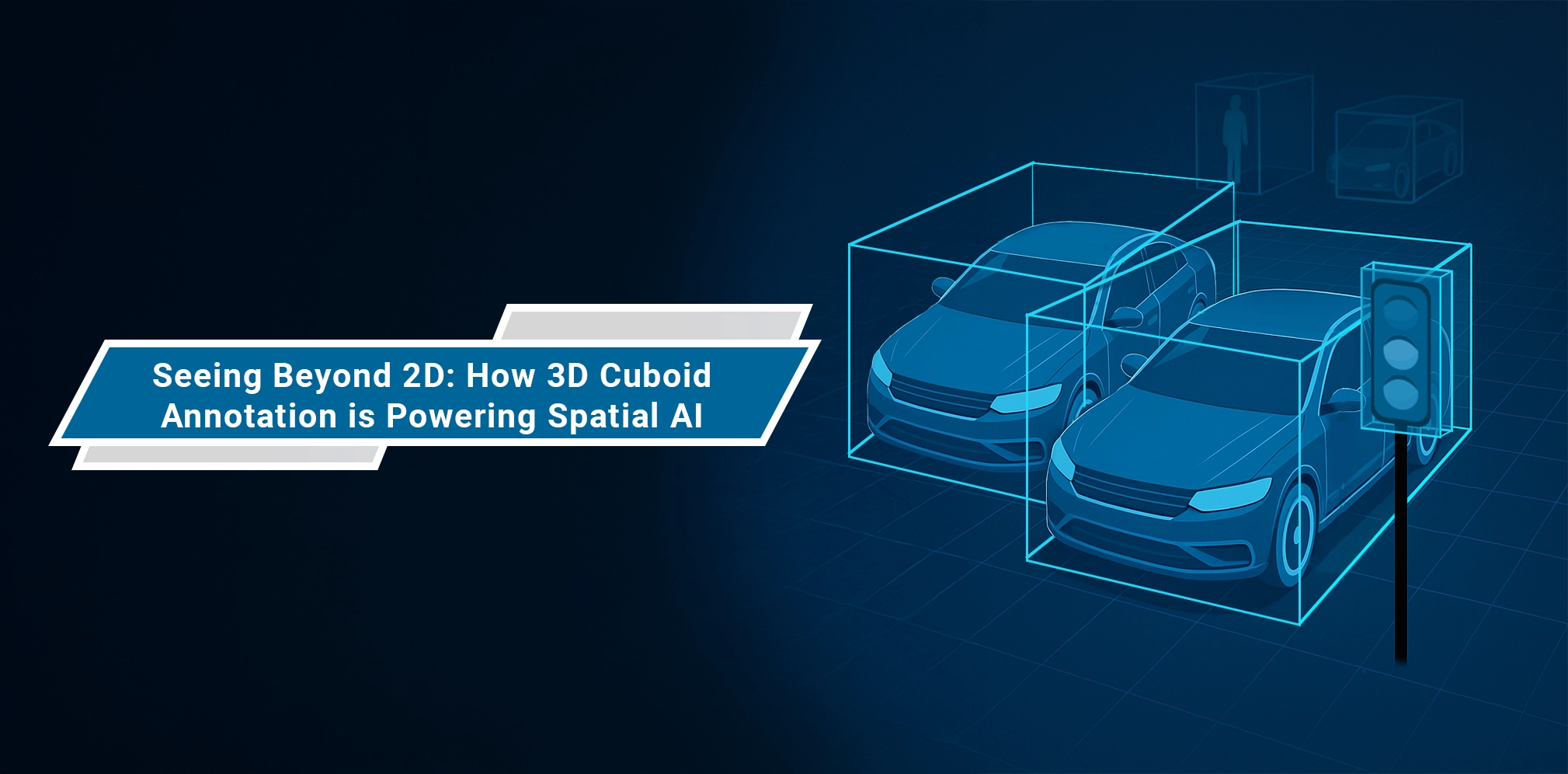
A 3D cuboid annotation is a rectangular prism that encloses an object’s spatial volume. Defined by eight vertices and aligned along three axes, the cuboid conveys not only an object’s position in the frame but its depth and orientation. This geometric representation allows models to infer how far an object is, how it’s positioned, and whether it’s tilted, turning, or aligned with its surroundings. This process is often called cuboid annotation or 3D cuboid image annotation.
This level of annotation is particularly useful in systems powered by LiDAR, stereo cameras, or sensor fusion setups. It’s common to pair 3D cuboid image annotation with point cloud data or panoramic imaging to provide multi-perspective visibility and create a comprehensive depth map.
At NextWealth, annotators undergo domain-specific training to understand these sensor modalities and calibrate annotations to real-world geometries. The human-in-the-loop (HITL) process is central to achieving this precision. Annotators don’t just draw; they interpret, verify, and contextualize, ensuring that what the model learns is grounded in physical accuracy.
3D vs. 2D Annotations: Enhancing Fidelity and Function
The difference between 2D annotation and 3D annotation is not merely dimensional; it’s functional. 2D annotations treat objects as flat silhouettes; 3D cuboids treat them as interactive entities. This distinction is pivotal in high-stakes applications.
For instance, in a project involving autonomous fleet navigation through urban and semi-urban landscapes, 2D annotations could not differentiate between a parked vehicle and one preparing to move. By introducing 3D cuboid annotations, the model began understanding vehicle orientation and motion intent.
In another case within automated retail checkout systems, cuboid labeling enabled depth-based object separation, distinguishing overlapping items on a shelf with remarkable precision. NextWealth implemented automated pre-annotation using proprietary scripts, followed by three-layer human QA to eliminate edge-case errors and drastically improve training data consistency.
Empowering AI Decision-Making with Spatial Context and Depth Perception
Depth perception is foundational to intelligent decision-making. With cuboid annotation, AI models begin to approximate human-like understanding of space. They can measure proximity, avoid collisions, track trajectories, and adapt to dynamic environments. This is critical for developing robust cuboid AI systems.
In warehouse robotics, this means identifying the precise stacking order of boxes. In smart surveillance, it enables distinguishing whether a person is inside or outside a defined zone. NextWealth annotators are trained to account for spatial cues such as shadow lines, object overlap, and multi-frame context—traits that automated tools often overlook.
By embedding human expertise into the annotation lifecycle, we ensure that the AI is not just trained faster, but trained better. The result: models that perform robustly in live environments, not just on test datasets, leading to superior object detection 3D capabilities.
Use Cases Across Industries: Autonomous Driving, AR, Robotics & More
3D cuboid annotation services are the backbone of many spatial AI systems. They are extensively used in:
- Autonomous Vehicles: Mapping other vehicles, road barriers, pedestrians, and infrastructure in 3D, crucial for autonomous driving annotation.
- Augmented Reality: Anchoring virtual assets with real-world alignment, enabling precise augmented reality annotation.
- Robotics: Spatial navigation, grasping, and manipulation, vital for robotics annotation and various robotics applications.
- Industrial Inspection: Measuring alignment, fitment, and depth deviation in machinery.
In a recent project supporting indoor drone navigation, NextWealth teams processed panoramic imagery and LiDAR overlays to annotate doorways, beams, and obstacles using precise 3D cuboid annotation. Annotators reviewed object interactions across multiple frames to improve continuity labeling, ensuring seamless drone navigation. This often involves LiDAR annotation for highly accurate spatial data.tors reviewed object interaction over multiple frames to improve continuity labelling, ensuring seamless navigation capability for the drone.
Scaling Annotation with HITL and Automation Synergy
As data volumes increase, scalability becomes essential. However, scaling without compromising quality is a challenge that NextWealth tackles with a layered human-in-the-loop annotation model combined with intelligent automation.
For a retail checkout AI start-up, we automated basic cuboid rendering based on shelf maps and depth estimates. Human annotators then refined the results, focusing on edge cases like irregular packaging, reflections, and partially visible items. Domain experts reviewed complex items like bottles and containers where AI alone struggled with perspective variance.
By integrating micro-automation scripts, we cut annotation time significantly while maintaining high-quality thresholds. Our model relies on distributed annotation teams, active learning loops, and statistical quality dashboards to drive both throughput and accuracy, making us a leading provider of data annotation services.
Toward Contextually Aware AI: The Road Ahead
3D cuboid annotation is not just a data task; it is a critical enabler for context-aware AI. As models evolve from static classifiers to interactive agents, the need for spatially accurate, context-rich ground truth grows exponentially. Advanced 3D cuboid annotation tools continue to push these boundaries.
At NextWealth, we don’t just provide annotation services; we co-create training data strategies that align with model goals. Whether the goal is object tracking across video frames or hybrid sensor alignment for multi-modal learning, our teams combine tooling proficiency with domain intelligence.
In the age of AI autonomy, depth isn’t just a visual dimension; it’s a strategic one. And 3D cuboid annotation is how we help AI see the world the way we do: richly, dynamically, and precisely. This includes advancements in monocular depth perception, allowing AI to infer depth from a single 2D image.
To Conclude: Depth Perception Is the New Frontier in Vision AI
As AI systems move beyond static image recognition, depth-aware annotation is becoming a foundational layer of intelligence. As industries increasingly rely on AI to interact with physical environments – whether through drones, robots, or autonomous fleets – the margin for error is razor-thin. 3D cuboid annotation stands as a critical differentiator in this new age of spatial computing. And it’s not just about accurate labels; it’s about trusted, context-aware data pipelines that scale. At NextWealth, our proven expertise in high-quality, HITL-driven workflows and intelligent automation ensures your models don’t just see, but truly understand. Whether you’re building the next big leap in autonomous technology or optimizing existing perception pipelines, NextWealth brings the right blend of Precision, scale, and domain understanding to annotate the world in 3D.
Ready to elevate your vision in 3D? Connect with our annotation experts today!
FAQ
What is 3D cuboid annotation?
3D cuboid annotation is a technique in computer vision where objects are labeled in 3D space using rectangular prisms or cuboids. These cuboids not only mark an object’s position but also represent its depth, orientation, and spatial relationships. This method allows AI models to understand objects in their actual 3D environment, crucial for applications like autonomous vehicles, robotics, and augmented reality.
Can 3D cuboid annotation enhance AI’s performance in autonomous vehicles?
Yes, 3D cuboid annotation is essential for autonomous vehicles. It helps AI systems map out their surroundings, recognizing the position, distance, and orientation of other vehicles, pedestrians, and obstacles, which is crucial for safe navigation and decision-making in dynamic environments.
What is the role of Human-in-the-Loop (HITL) in 3D cuboid annotation?
The Human-in-the-Loop (HITL) process involves human annotators reviewing and refining AI-generated annotations. This ensures high accuracy, especially in complex scenarios where AI alone may struggle, such as handling occlusions, reflections, or partially visible objects. HITL adds an extra layer of precision by allowing human experts to interpret and contextualize the data.
How does NextWealth ensure high-quality 3D cuboid annotation?
At NextWealth, we combine human-in-the-loop (HITL) data annotation with advanced automation to ensure the highest level of accuracy in 3D cuboid annotation. Our human annotators verify and refine AI-generated annotations, ensuring that each annotation is contextually accurate and precise, even in complex or ambiguous scenarios. This process guarantees reliable, high-quality training data for your AI models.