
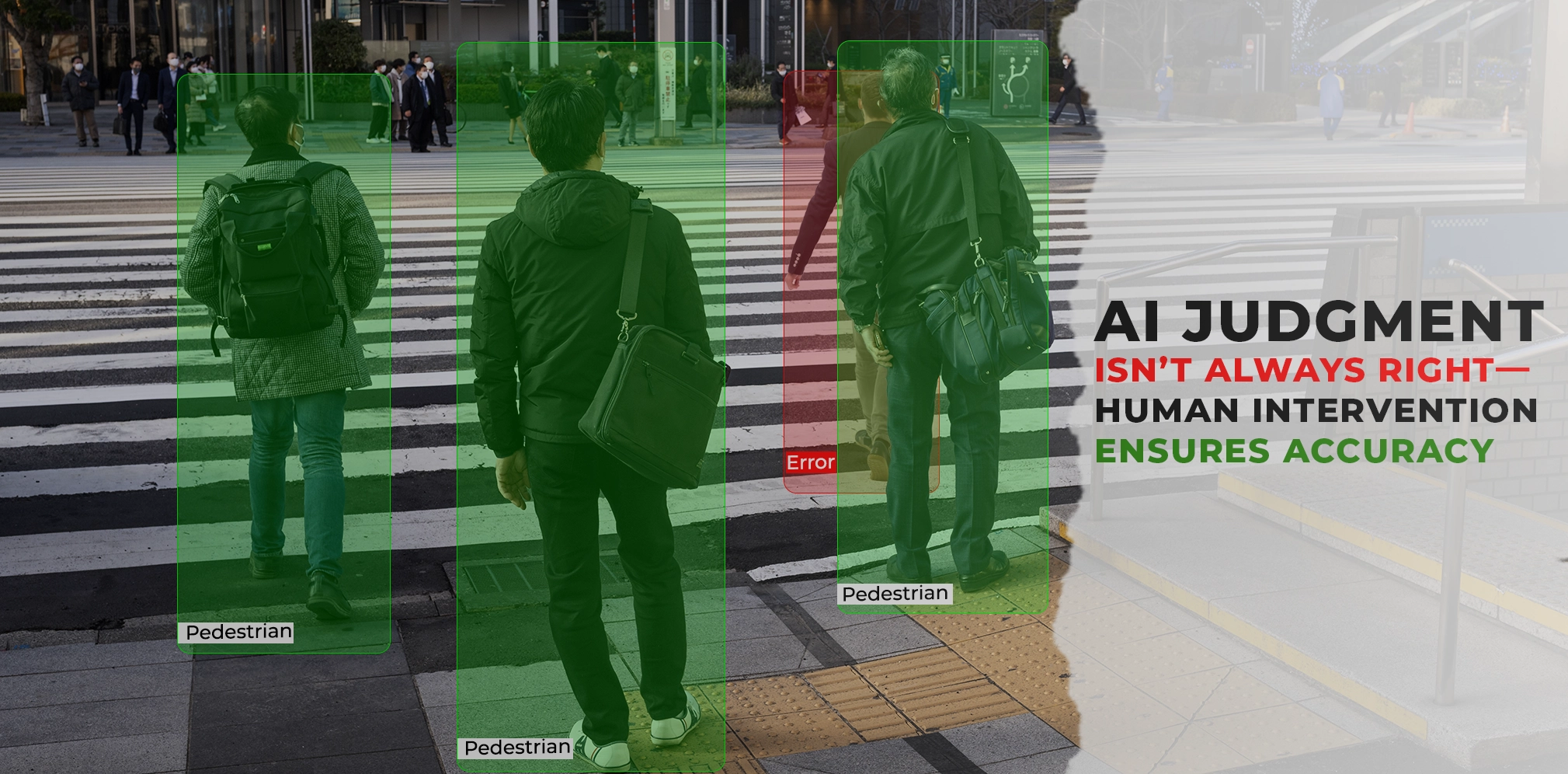
Quick Overview
This blog highlights the significance of Human-in-the-Loop (HITL) in boosting computer vision accuracy. It delves into how HITL methodologies enhance AI model performance by incorporating human validation during the training and annotation stages. The integration of human expertise mitigates errors, reduces bias, and ensures the accuracy of computer vision systems in complex applications.
Key points include:
- How HITL improves the accuracy and resilience of computer vision models
- The critical role of human intervention in correcting edge cases and improving model reliability
- The growing demand for HITL in industries like autonomous vehicles, healthcare, and manufacturing
- Future trends in computer vision and the evolving role of HITL in AI systems
In the race to build smarter AI, one truth remains: AI is only as good as the data that trains it. For computer vision systems, where perception fuels decision-making, data accuracy isn’t a bonus—it’s a baseline. And that’s where Human-in-the-Loop computer vision becomes indispensable.
While automation accelerates AI development, the strategic inclusion of human expertise ensures quality, contextual precision, and real-world adaptability. In this article, we explore how Human-in-the-Loop (HITL) significantly enhances the performance and reliability of computer vision models, especially in high-stakes domains like autonomous vehicles, manufacturing, healthcare, and retail..
Overcoming Accuracy Barriers in Vision AI with Human-in-the-Loop
Despite their advancements, computer vision AI models often fail under edge cases—such as occlusions, lighting variations, synthetic training biases, or rare object perspectives.
Consider this: a segmentation model trained in daylight conditions may misclassify road elements under dusk or fog. Similarly, synthetic datasets that simulate traffic scenes might hallucinate object boundaries or overlook depth cues critical for ADAS systems.
By integrating Human-in-the-Loop (HITL), such limitations are mitigated. Human annotators, equipped with real-world context and domain-specific understanding, validate and correct these errors. They ensure that occluded pedestrians are correctly labelled, poorly lit lane markings are accurately segmented, and ambiguous edges are traced with human precision.
The result? Greater robustness and generalizability in production models.
Designing HITL Systems for 3D and Depth-Perception Accuracy
Vision systems that interpret 3D space—like autonomous vehicles, robotics, and AR/VR—demand a nuanced understanding of spatial depth and perspective. These use cases rely on tasks such as 3D cuboid annotation, point cloud segmentation, or LiDAR-camera fusion—areas where fully automated models still struggle.
Human reviewers play a critical role in ensuring accuracy here. For instance:
- Bounding box alignment: Annotators correct misaligned boxes around vehicles or objects at oblique angles.
- Perspective correction: They fine-tune annotations across vanishing points in urban scenes.
- Depth cue validation: In LiDAR data, humans help resolve point overlaps, missing signals, or irregular object shapes.
Without HITL involvement, even a small error in 3D perception can cascade into flawed navigation or abrupt robotic movement decisions.
Human-Guided Annotation Workflows for High-Precision Perception
High-fidelity training data is the backbone of reliable computer vision systems. However, not all annotations are equal. Challenges like overlapping objects, fuzzy edges, and complex environments demand human discernment, especially in industries like healthcare and manufacturing.
At NextWealth, our HITL workflows combine best-in-class tools like CVAT, Label Studio, and proprietary QA dashboards to implement multi-stage annotation pipelines, including:
- First-pass annotation by trained workers
- Expert review with contextual refinement
- QA sampling and consensus validation
This layered approach results in precision datasets where quality can exceed 98% accuracy, even in complex visual tasks like surgical tool segmentation or micro-defect identification in industrial inspection.
Creating Feedback Loops for Continual Learning
One of the most underappreciated benefits of Human-in-the-Loop (HITL) is its role in AI model training and iteration. Human reviewers don’t just validate—they also flag false positives, catch edge cases, and surface new patterns.
This feedback loop becomes especially valuable in dynamic environments:
- In urban traffic, new vehicle types, pedestrian behaviours, or infrastructure updates can confuse static-trained models. Human-in-the-Loop (HITL) helps models evolve with the city.
- In retail, shelf restocking or packaging changes require annotation tweaks that automated models can miss.
- In agriculture, seasonal changes and crop variations demand human oversight to maintain relevance.
By capturing these deviations and feeding them back into training pipelines, Human-in-the-Loop (HITL) ensures that AI models learn continuously and adapt intelligently.
Scaling HITL for Enterprise-Grade Accuracy
Accuracy is not enough for enterprise deployments—you also need to be fast and scalable.
NextWealth’s hybrid pipelines are built to deliver just that. Our models operate with human QA gates, enabling:
- High throughput (e.g., 10,000+ frames/day)
- Precision improvements (5–15% accuracy boost post-HITL)
- Scalable FTE models, adaptable by object density and annotation complexity
We’ve seen these systems succeed in production scenarios—from improving safety margins in L3 autonomous vehicles to reducing false positives in quality inspection lines for global manufacturing clients.
Why HITL is the Future of Trustworthy AI
With the rise of foundation models and self-supervised learning, it’s tempting to believe that human effort in AI pipelines is becoming obsolete. But the truth is: as models get smarter, their need for contextual grounding becomes sharper.
Human-in-the-Loop (HITL) isn’t a bottleneck—it’s the cognitive safeguard that ensures AI models don’t just see but understand.
For industries relying on vision AI, Human-in-the-Loop (HITL) ensures:
- Trustworthy predictions, even in uncertain scenarios
- Reduced bias from poorly represented edge cases
- Improved compliance through auditable annotation trails
In short, if you’re building AI that operates in the real world, real humans need to be in the loop.
Final Thoughts
At NextWealth, precision, accountability, and adaptability are the pillars of scalable AI. That’s why we design every computer vision system with Human-in-the-Loop (HITL) as the foundation—not an afterthought.
Whether it’s autonomous driving, visual quality inspection, or healthcare diagnps 85tics, our human-in-the-loop workflows consistently deliver the computer vision accuracy and reliability that tomorrow’s AI models demand.
Looking to scale your computer vision systems with human-grade precision?Let’s talk.
FAQ
1. What is Computer Vision Accuracy and Why is it Important?
and interpret visual data. It plays a crucial role in ensuring that the AI model makes precise predictions or classifications based on images or video feeds. Accuracy is especially important in high-stakes applications like autonomous driving, medical imaging, and quality control, where errors can lead to significant consequences. By improving computer vision accuracy, companies can enhance the reliability and trustworthiness of AI systems, ensuring more effective and safer outcomes in real-world scenarios.
2. How Does Human-in-the-Loop (HITL) Enhance Computer Vision Models?
Human-in-the-Loop (HITL) significantly boosts the performance of computer vision models by introducing human expertise into the training and decision-making processes. While automated systems can process vast amounts of data, they often struggle with edge cases, such as occlusions, complex backgrounds, or unfamiliar objects. HITL involves human reviewers who correct model errors, validate predictions, and fine-tune the system. This combination of AI automation and human insight leads to more accurate, adaptable, and robust computer vision systems, especially in high-risk industries such as healthcare and autonomous driving.
3. What is a Computer Vision System and How Does it Work?
A computer vision system is a type of AI technology designed to interpret and analyze visual data from the world. It uses machine learning algorithms to process images, videos, or real-time camera feeds and recognize patterns, objects, or scenes. These systems are powered by deep learning models that can be trained to identify a wide range of objects, from everyday items to more specialized targets, such as tumors in medical scans. The goal of a computer vision system is to make machines capable of understanding visual information in a way that mimics human vision, which is fundamental for applications like autonomous vehicles, surveillance, and industrial automation.
4. Why is Human-in-the-Loop (HITL) Crucial for Computer Vision Systems?
Human-in-the-Loop (HITL) is crucial for improving the quality and reliability of computer vision systems. While AI models can process large datasets quickly, they often make mistakes, especially in unpredictable or complex situations. HITL allows human annotators to intervene, verify, and correct errors, ensuring that the system learns from real-world context. This not only improves computer vision accuracy, but also helps the model adapt to new scenarios, edge cases, and evolving environments. By maintaining a balance between AI and human expertise, HITL enables more precise, adaptable, and trustworthy computer vision systems, making it indispensable in industries like autonomous driving, healthcare, and manufacturing.