Synthetic Data Annotation & Validation Services

Human-verified synthetic data you can actually train on

Synthetic data promises scale on demand: millions of examples, rare edge cases on request, no privacy headaches. But generated data has a quiet failure mode, it can look flawless and still be wrong. A mislabeled rendered pedestrian, an LLM-written answer that is fluent but false, a synthetic patient record that drifts from real clinical patterns: none of these raise an error, they just teach your model the wrong thing, and the damage compounds with every training cycle. The data that looks too clean is often the data most worth checking. That is the job of synthetic data annotation and validation, putting human judgment between the generator and your training pipeline.
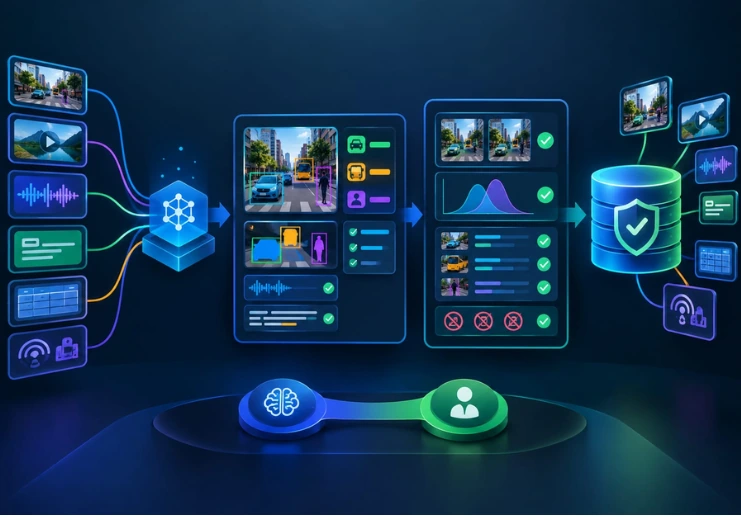
What is Synthetic Data Annotation and Validation Services?

Synthetic data annotation and validation is the process of labeling, reviewing, and quality-checking artificially generated data like text, images, video, audio, tabular records, or simulated sensor data so it is accurate, realistic, diverse, unbiased, and safe to use for training and evaluating AI models.

The work has two connected halves:

  • Annotation adds or corrects labels on synthetic data: verifying auto-generated labels, tagging attributes, segmenting generated or rendered images, and ranking or scoring generated text.
  • Validation tests whether the synthetic data is fit for purpose: whether it matches the statistical and visual characteristics of real-world data, covers the cases that matter, carries correct labels, and is free of harmful bias, unsafe content, or leaked private information.

Why does this need people? Generators inherit the biases and blind spots of the data and models behind them, and automated checks including an LLM acting as judge can share those same blind spots. Research on training with generated data has also shown that models trained mostly on the output of earlier models can lose diversity and amplify errors over generations, a risk often called model collapse. The practical remedy most teams converge on is a hybrid: synthetic data for scale, anchored by a smaller, carefully verified human-reviewed core that keeps the whole dataset grounded in reality.

Types of Computer Vision Annotation

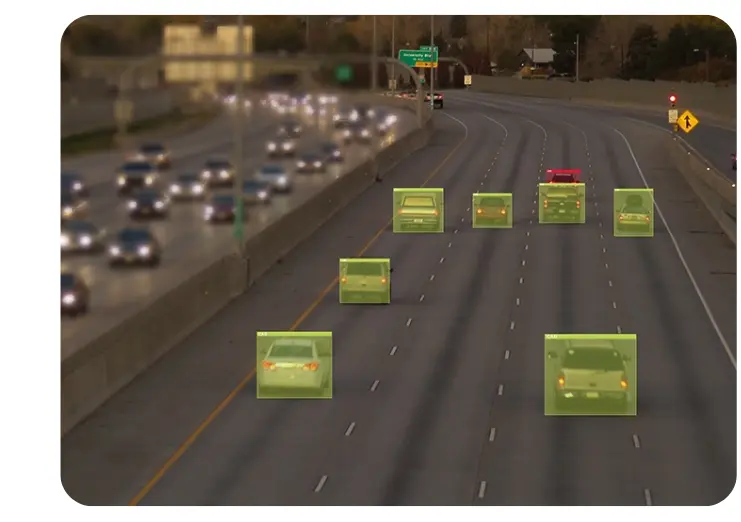
Image Annotation

Image annotation includes bounding boxes, polygons, segmentation, and keypoints to label objects, faces, and features within images. It’s critical for training AI in object detection, facial recognition, and visual understanding. These annotations help computer vision systems in autonomous vehicles, retail, healthcare, and robotics interpret real-world imagery accurately. Read More
Image Annotation

Video Annotation

Video annotation involves frame-by-frame tracking and temporal labeling of people, objects, and actions. It enables behavior analysis for surveillance, autonomous driving, and sports analytics. Accurate annotations ensure that computer vision models understand motion, direction, and events over time—making video a valuable input source for real-time decision-making systems. Read More
Video Annotation

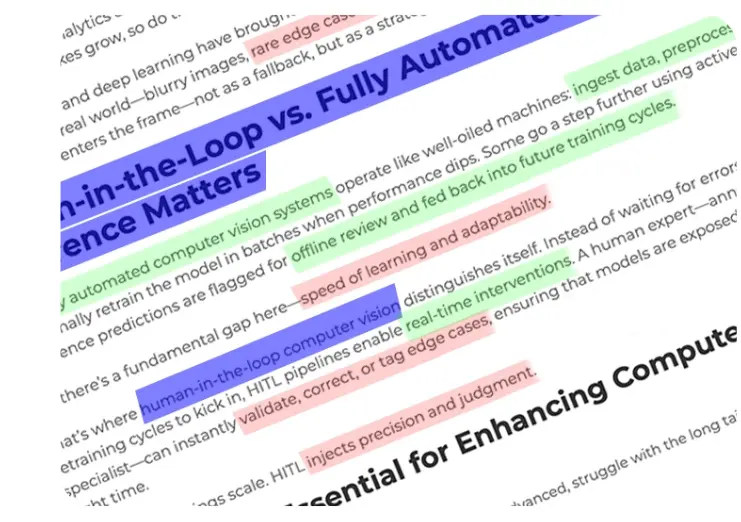
Text Annotation

Text annotation includes named entity recognition (NER), sentiment tagging, and intent classification. It supports NLP applications like chatbots, document parsing, and fraud detection. Annotated text helps language models extract meaning, understand user context, and respond accurately, enabling smarter automation in customer support, finance, and regulatory compliance systems.
Text Annotation

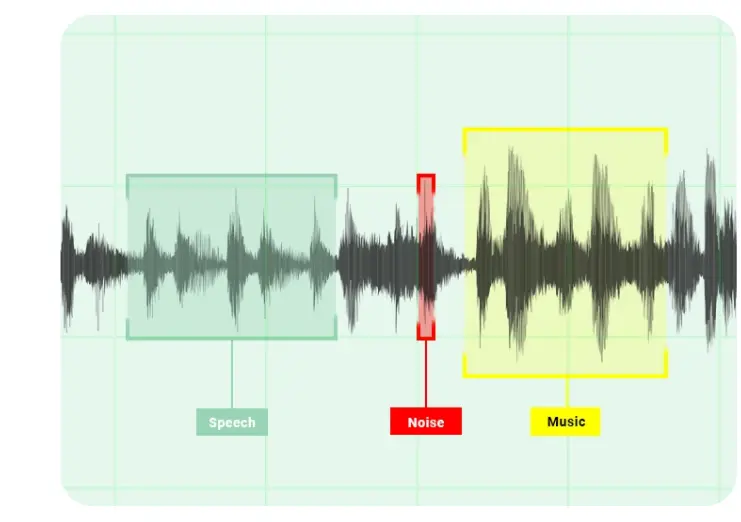
Audio Annotation

Audio annotation tags spoken language with speaker identification, transcription, and intonation marking. It helps train voice assistants, call center AI, and language recognition tools. Annotators distinguish between speakers, mark pitch or emotion changes, and convert audio to text—enhancing performance in multilingual, real-time, or emotionally sensitive voice applications.
Audio Annotation

3D / LiDAR Annotation
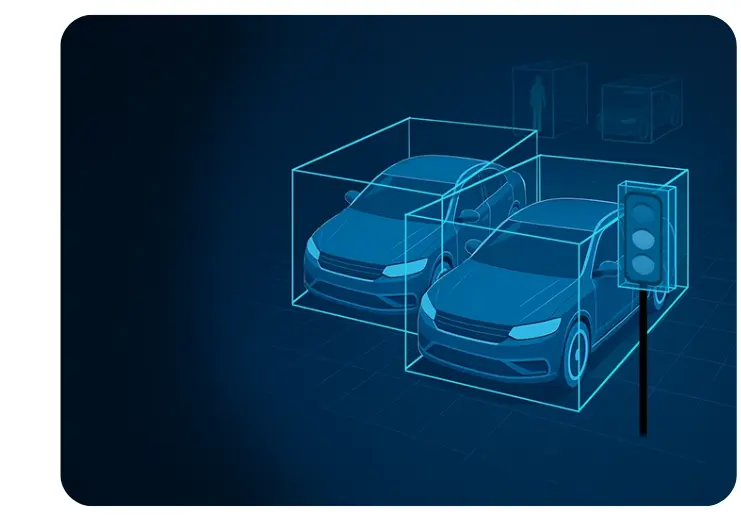
3D or LiDAR annotation applies cuboids, semantic segmentation, and depth mapping to point cloud data. It is essential for autonomous vehicles, robotics, and HD mapping. Annotators label objects in three-dimensional space to help AI understand object size, distance, and position—crucial for safe, spatially aware navigation.
3D / LiDAR Annotation

Synthetic Data QA
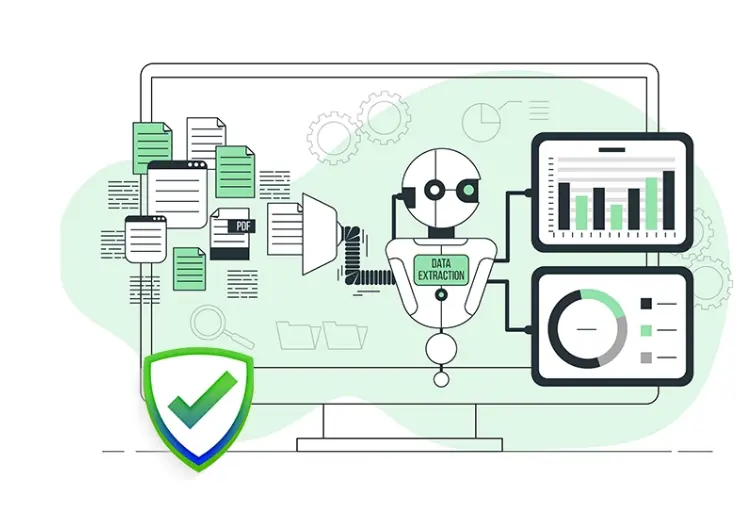
Synthetic data QA ensures that artificially generated data meets quality and realism standards. Human annotators validate edge cases, simulation scenarios, and synthetic annotations for consistency, diversity, and context. This process improves model robustness by exposing it to rare or complex events, making it ready for real-world deployment.
Synthetic Data QA

Types of Synthetic Data Annotation and Validation
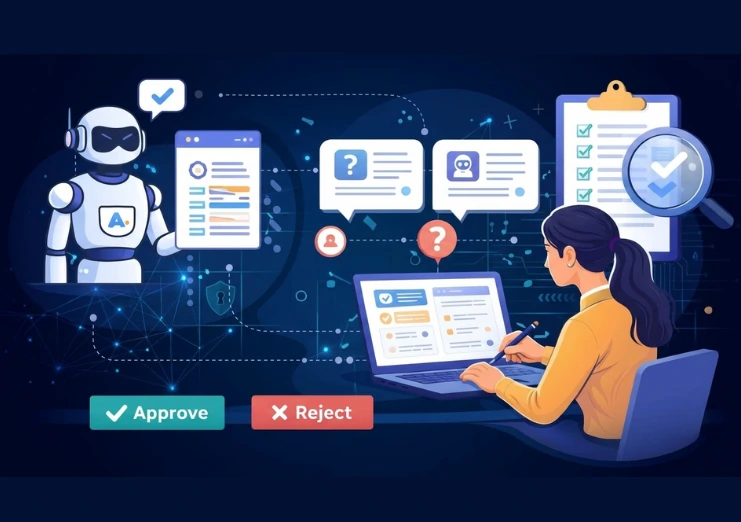
Human reviewers assess generated instructions, dialogues, answers, and summaries for factual accuracy, instruction-following, tone, coherence, and policy compliance, and flag fluent-but-wrong output that automated filters miss.

Annotators verify and correct labels on generated or rendered imagery like bounding boxes, segmentation masks, keypoints, and attributes and flag visual artifacts, impossible physics, and unrealistic textures that give a dataset away as fake.

Simulated scenes from game engines and simulators arrive with automatic ground-truth labels. Audits check those labels for errors and test how well the data transfers to real-world conditions, the so-called sim-to-real gap.

Reviewers check generated point clouds and multi-sensor sequences for geometric consistency, object placement, and realistic noise, so perception models are not trained on physically implausible scenes.

Native-speaker reviewers rate generated speech for naturalness, pronunciation, accent, and transcript accuracy, and check that synthetic voices and dialects represent the intended population.

Checks that generated records preserve the distributions, correlations, and business rules of the source data, remain internally consistent, and do not leak or reproduce sensitive real records.

Structured sampling and scoring of whether a synthetic dataset matches real-world characteristics, spans the full range of scenarios, and includes rare edge cases rather than repeating a narrow set of patterns.

Expert review of generated data for demographic skew, stereotyping, toxic or unsafe content, and traces of personal or proprietary information before it reaches training.


Human-labeled gold sets are used to measure how well automated judges agree with people, to catch judge bias, and to keep automated quality scoring honest over time.

Applications and Use Cases

Autonomous driving and robotics

Teams generate rare and dangerous scenarios in simulation. Human audits confirm labels are correct and that the scenes are realistic enough to improve real-world perception rather than mislead it.

Healthcare and life sciences

Synthetic records and medical images can protect patient privacy, but clinical reviewers are needed to confirm the data is medically plausible and does not reproduce real individuals.

Banking, financial services, and insurance

Synthetic transactions and customer data support fraud and risk models. Validation confirms realistic patterns, preserved statistical relationships, and no leakage of real account information.

LLM instruction, reasoning, and preference data

Model-generated training examples are reviewed for correctness, diversity, and quality before fine-tuning, with human-verified subsets used to anchor and benchmark the rest.

Trust, safety, and red-teaming

Synthetic adversarial prompts and harmful-content examples expand safety coverage, with human review ensuring labels reflect policy and sensitive content is handled responsibly.

Manufacturing and visual inspection

Generated defect images fill gaps where real defects are rare. Annotators verify defect labels and confirm the images resemble what cameras on a real line will see.

Retail and e-commerce

Synthetic product imagery, catalog text, and shopper queries improve search and recommendation models once attributes and descriptions have been checked for accuracy.

Low-resource languages and regional AI

Synthetic text and speech help where real data is scarce, and native-speaker validation ensures the language, dialect, and cultural context are authentic.

Software testing and QA

Generated test data and edge-case scenarios are validated for realism and coverage so that test results actually predict production behavior.


Successful client stories and case studies

Deep dive into our journey of partnering with the global business giants.

Computer Vision

Computer Vision

project to identify phishing threats

3 mins read

Learn More
Computer Vision

Facial Annotation

features using object detection and classification

3 mins read

Learn More
Computer Vision

Training Datasets

for machine learning algorithms

3 mins read

Learn More

Why partner with us

Our services are tailored to elevate the efficiency of your AI/ML processes
Managed Services l Captive Services l Staffing Services

5,000+

Skilled
Employees

1B+

Data
Transactions

40+

Live Projects

10+

Fortune 500
Clients

85

NPS Score

Testified and trusted by
the best in the world of business

I am really happy at all the great things we have been able to achieve in the past 1 year. The relationship now has a solid foundation, and I am sure NextWealth will continue to be a formidable partner going ahead, bringing a delightful experience for our customers.

Sr. Program Manager Fortune 10 Technology Company

NextWealth has been an invaluable partner to us, significantly accelerating our growth by handling critical data operations and providing strategic insights.

Founder India’s Largest Market and Competitor Intelligence Company

NextWealth’s hard work and dedication are truly making a difference, streamlining our processes significantly. We really appreciate it!

Principal AI & Machine Learning Scientist Global Leader in Threat Detection and Security Screening

My experience with NextWealth has been wonderful. The diligent team consistently delivers on time with a focus on quality. Their innovation-driven mindset fosters a win-win situation for both teams.

eCommerce Strategy Manager Europe’s Leading Fashion and Lifestyle Platform

I am happy with the improvement in the performance. I have seen positive improvement, and we have a long way to go.

Staff Technical Operations Manager Fortune 10 American Retail MNC

NextWealth’s in-depth analysis helped us pinpoint exactly what needs to be done to address the issues.

Specialist Quality Services, Fortune 10 Technology Company

With excellence in Quality, Cost, and TAT—key pillars of any operation—NextWealth sets a benchmark for operational efficiency and beyond.

Associate Director Indian Equity Research Company

We have experienced significant growth—a success we could not have achieved without the expert support, hard work, and commitment of NextWealth.

CEO Leading Marketing Agency

Explore Resources

Know how we are accelerating business growth by enabling effectiveness in AI/ML

Data Annotation and Labelling – How HITL Enhances Accuracy in AI Model Development

How Many Data Annotators Do You Actually Need? A Benchmark of 20M+ Monthly Annotations Across LiDAR, Video & Geospatial Projects

3 mins read

Natural Language Processing

The True Cost of Model Rework

3 mins read

Latest Update

Data Annotation and Labelling – How HITL Enhances Accuracy in AI Model Development

Data Annotation Accuracy Benchmarks 2026: 95–100% Quality Rates Across Computer Vision, Trust & Safety, and Generative AI

3 mins read

FAQs

What is synthetic data annotation?

Synthetic data annotation is the labeling, correction, and review of artificially generated data, such as verifying auto-generated labels on rendered images, tagging attributes, or scoring AI-written text, so the data can be used reliably to train or test machine learning models.

What is synthetic data validation?

Synthetic data validation is the process of checking whether generated data is fit for purpose. It tests fidelity to real-world data, diversity and coverage, label accuracy, bias, safety, and privacy, and typically combines automated metrics with human review.

Why does synthetic data need human validation?

Generators inherit the biases and gaps of their source data and models, and automated checks can share the same blind spots. Human reviewers catch plausible-looking errors, subtle artifacts, and domain mistakes that statistical tests and AI judges often miss.

What is model collapse?

Model collapse is the degradation that can occur when models are trained repeatedly on data generated by earlier models. Diversity shrinks, errors and biases are amplified, and quality declines over generations. Keeping verified real or human-reviewed data in the mix is the common safeguard.

Can synthetic data replace real data?

Rarely in full. Synthetic data works best as a complement, adding scale, rare edge cases, and privacy protection, while a smaller verified core of real or human-reviewed data keeps the model anchored. How much synthetic data is appropriate depends on how much risk the task carries.

How is the quality of synthetic data measured?

Common dimensions include fidelity (how closely it resembles real data), diversity and coverage, label accuracy, downstream utility (how well models trained on it perform on real data), and privacy and bias checks. Human review sampling is used to confirm what automated metrics report.

What is the sim-to-real gap?

The sim-to-real gap is the difference between simulated or generated data and real-world conditions. Models trained on overly clean or unrealistic synthetic data can perform well in testing but poorly in deployment, which is why realism audits and real-world evaluation matter.

How does human review work alongside LLM-as-judge scoring?

Automated judges score large volumes quickly, while humans label a gold set to measure how well the judge agrees with people, review borderline cases, and periodically audit for judge bias. The combination keeps scoring scalable without letting it drift from human standards.

Subscribe To Our Newsletter

Join our mailing list to receive the latest news and updates from our team.

2026 Enterprise AI Report

The Enterprise AI Buyer's Checklist

  • ✓ Security & compliance certifications to require
  • ✓ Quality control & SLA benchmarks to demand
  • ✓ A 25-point scorecard to rate any vendor

Evaluating HITL vendors?

Score your AI data partner before you sign.

A free 3-part checklist covering data security, quality control, and SLA terms — everything you need to score a prospective AI data partner.

[contact-form-7 id="ac83726" title="Enterprise AI Checklist Lead"]

You have Successfully Subscribed!