
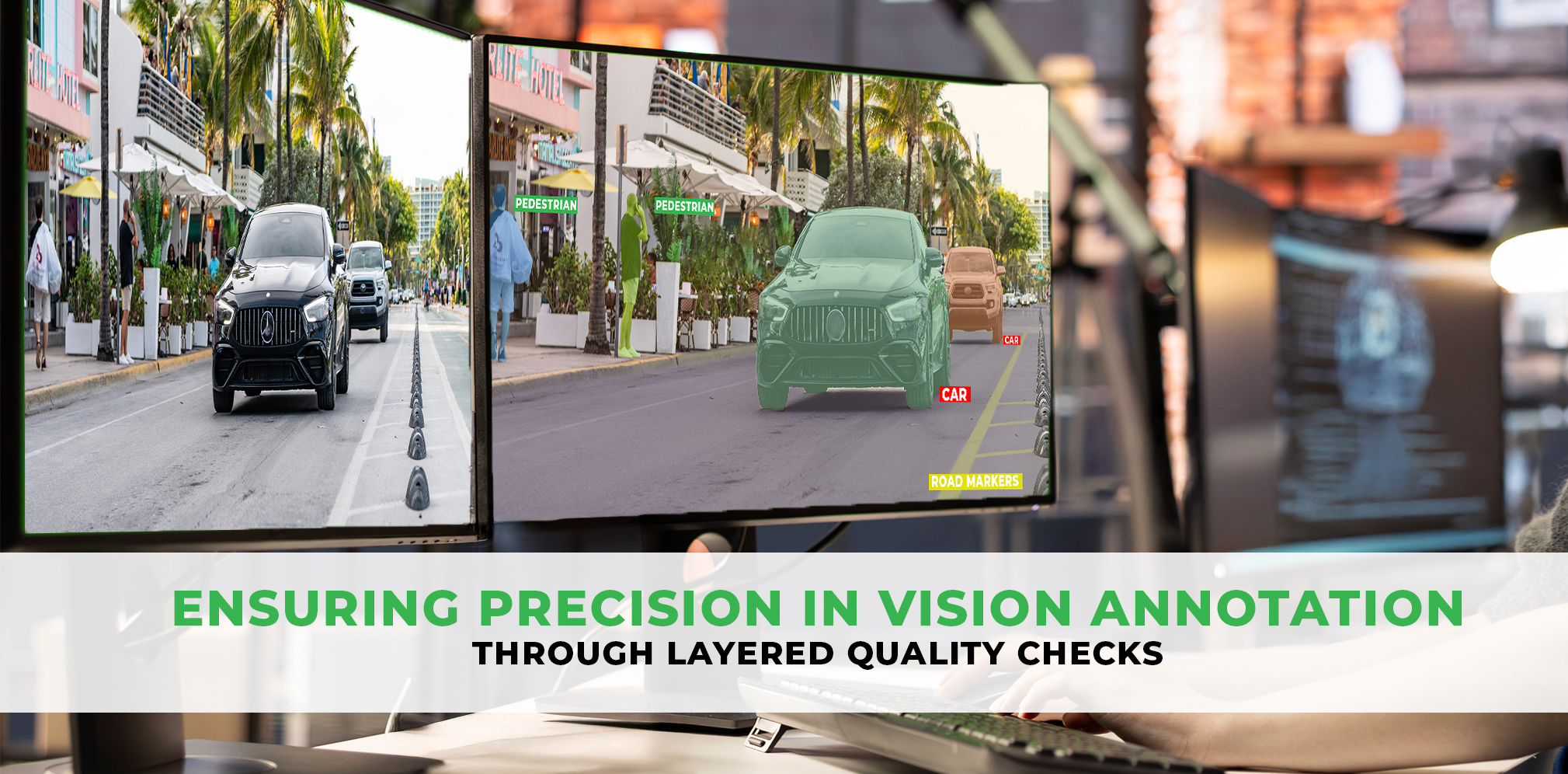
Key takeaways
- Computer vision models fail more often because of flawed training data than because of weak algorithms.
- Label errors are common: researchers found an average of 3.4% mislabeled examples across 10 popular benchmark test sets.
- Multi-stage quality control catches errors at three checkpoints: peer review, domain expert verification and a gold-standard audit.
- Layered QC gives cleaner ground truth, less labelling bias and the audit trail regulated industries need.
Why quality control decides whether vision models work
In computer vision, quality control in annotation decides whether a model can be trusted in the real world. One mislabeled frame can lead to a missed tumour on a scan, a wrong lane change by an autonomous vehicle, or a security camera that ignores a real threat.
Label errors are more common than most teams expect. A study by researchers from MIT and Amazon found an average of 3.4% label errors across 10 widely used test sets, including about 6% of the ImageNet validation set. If well-known benchmark datasets carry that many errors, production datasets without a structured review process can carry more.
That is why annotation QC cannot be a final checkbox. The goal is not just labelled data, but correctly labelled data, delivered consistently at scale. This post explains how multi-stage quality control works, why it beats a single review, and how NextWealth runs it in production.
Challenges of annotation accuracy at scale
Getting labels right on a small pilot dataset is manageable. The problems start when projects grow to millions of frames, objects and attributes.
- Volume: modern computer vision projects can require tens of millions of annotated objects across images and video. Each frame may carry several bounding boxes, polygons, attributes and metadata tags.
- Task complexity: teams must handle semantic segmentation, instance segmentation, lane marking, object tracking across video frames, 3D cuboids for LiDAR and sensor fusion. Each task needs different skills.
- Subjectivity: with hundreds of annotators working at once, interpretations drift. Is that distant, blurred shape a pedestrian or a pole? Edge cases like this need domain knowledge.
- Changing guidelines: rules often change mid-project, and every annotator must adopt the change the same way.
- Error propagation: a misunderstood rule that slips past early checks is repeated across thousands of frames, contaminating the dataset.
Without a strong QC framework, the result is costly rework, delayed deployment and weaker models.
What is multi-stage quality control in annotation?
Multi-stage quality control is a layered review process that checks annotations at several points instead of relying on one final review. Responsibility is shared across peers, domain experts and a gold-standard audit.
Stage 1: Peer review
A second annotator checks the first annotator’s work. This catches straightforward mistakes such as missed objects, loose boxes and wrong classes immediately, and builds accountability across the team.
Stage 2: Domain expert verification
Domain-trained reviewers handle ambiguous, complex or industry-specific annotations. Medical annotators validate tumour segmentation. Automotive specialists check lane-marking consistency and occluded pedestrians. Their knowledge ensures labels are correct in context.
Stage 3: Gold-standard audit
A final QA layer compares annotations against gold-standard data curated by subject matter experts (SMEs). Unresolved edge cases are escalated to SMEs for a final decision. This stage gives traceability and confidence in the finished dataset.
| Stage | Who reviews | What it catches |
|---|---|---|
| 1. Peer review | A second annotator | Missed objects, loose boxes, wrong classes |
| 2. Expert verification | Domain-trained reviewers | Ambiguous and industry-specific cases |
| 3. Gold-standard audit | SMEs, against curated reference data | Systematic errors, guideline drift, unresolved edge cases |
Why multi-stage QC improves model performance
Compared with a single round of QA, layered review improves both model results and business outcomes:
- More reliable ground truth: several checkpoints remove noise, giving cleaner data, better generalization, fewer false positives and higher recall.
- Less labelling bias: edge cases and subjective calls are handled consistently by experts, so bias does not skew predictions.
- Measurable quality: clients see quality reported as precision, recall and F1 score instead of an unexplained “final check”.
- Compliance readiness: in healthcare, insurance and automotive, regulators expect accurate, traceable data. Multi-stage QC provides the audit trail.
How NextWealth runs multi-stage quality assurance
At NextWealth, multi-stage QC is built into every project pipeline. The approach is human-in-the-loop first, AI-assisted and domain-driven.
- HITL-first: AI pre-annotation speeds up labelling, but every annotation passes through human-in-the-loop validation at several stages, so automation errors are caught.
- Multi-level review: peer review for base checks, expert review for complex cases, and gold-standard audits with SME escalation. No annotation leaves unchecked.
- Domain-trained teams: dedicated teams for healthcare, automotive and retail reduce misinterpretation of domain-specific cases.
- Scale through process: SOP-driven workflows let projects grow from a pilot dataset to millions of frames without losing quality.
For more on how quality affects cost, read the true cost of bad training data.
Conclusion
A computer vision model’s success is decided long before deployment, by the quality of the data it learns from. One-time checks cannot guarantee that quality at scale. A disciplined, multi-stage process of peer review, expert verification and gold-standard audits can. For enterprises building production AI, choose an annotation partner that treats quality as an engineered process, not a final checkbox.
Frequently asked questions
What is multi-stage quality control in computer vision annotation? It is a layered review process where annotations are checked by peers, verified by domain experts and audited against gold-standard data, so errors are caught early and datasets are accurate.
Why do computer vision models need strong quality control? Mislabeled data teaches models wrong patterns, such as misidentifying objects or missing details. Strong QC reduces these errors and makes models safer in real-world use.
How common are label errors in datasets? A study of 10 popular benchmark test sets found an average of 3.4% label errors, including about 6% in the ImageNet validation set.
What are the main challenges in large-scale annotation projects? High volume, complex tasks such as segmentation and tracking, differences between annotators, changing guidelines, and errors that spread when not caught early.
How does peer review improve annotation quality? A second annotator checks the first one’s work, catching simple mistakes before they move further down the workflow.
How does expert validation improve AI datasets? Domain experts handle complex and ambiguous cases that general annotators may mislabel, ensuring labels are correct for the specific industry.
What is a gold-standard dataset in annotation QA? A reference set labelled and verified by subject matter experts. Annotations are compared against it to measure accuracy and spot systematic errors.
How does NextWealth ensure high-quality computer vision data? NextWealth combines peer checks, domain expert review and gold-standard audits with human-in-the-loop processes to deliver reliable, production-ready datasets.