

For global e-commerce platforms, the internal search bar is the single most critical piece of digital real estate. It is the direct gateway to transactional conversion. Industry-wide metrics show that up to 30% of all marketplace visitors head straight for the search box upon landing on a site. More importantly, these search-led shoppers exhibit an intent-driven purchasing behavior that makes them up to five times more likely to buy than standard window-shoppers.
Yet, despite massive investments in neural search architectures, vector embeddings, and large language models (LLMs), a glaring problem persists: “Search Abandonment.”
When a consumer types a specific, high-intent query and is met with irrelevant product matches, broken attributes, or a generic “No Results Found” page, they don’t change their search terms—they change websites. To fix this relevance gap, leading retail platforms are discovering that algorithmic fine-tuning is only half the battle. True discovery optimization requires high-precision, human-verified AI data services to clean catalog taxonomies, train query-matching models, and refine semantic intent.
1. The Cost of Bad Discovery: Why Algorithms Struggle Solo
E-commerce search engines face an incredibly complex linguistic challenge. Consumers do not search like computers; they use natural, ambiguous, and highly contextual language. A shopper typing “matte water-resistant phone cover for outdoor running” expects the system to instantly process:
- Core Entity/Noun: Phone cover
- Material/Finish Attributes: Matte
- Functional Property: Water-resistant
- Contextual Use-Case: Outdoor running
When an e-commerce platform relies purely on basic, automated text-matching algorithms, the system often breaks down. It might pull up running shoes, water bottles, or glossy phone cases, completely missing the contextual nuance.
This friction carries a severe financial penalty. According to extensive retail economic studies, global brands lose billions annually to search abandonment, directly impacting long-term customer lifetime value (LTV) (Briedis et al., 2025). The root cause is rarely the code itself; it is the underlying data structure. If product catalogs are plagued by messy, unverified metadata, or if training datasets fail to capture local colloquialisms, even the most advanced AI models will return irrelevant results.
2. The Core Pillars of E-Commerce Search Relevance Optimization
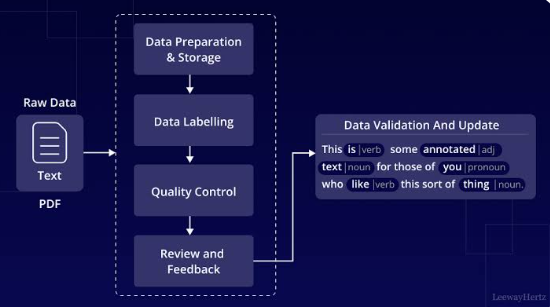
To transform a standard keyword-matching engine into a high-converting semantic discovery machine, data operations teams focus on four foundational pillars of catalog and search optimization:
Semantic Query-to-Product Matching
This involves training natural language understanding (NLU) models to identify synonymy, handle spelling errors, and decode hyper-specific user intent. AI data services provide human-labeled pairs that grade the exact degree of relevance between a search term and an item description. This structural training ensures that a query for “crimson trainers” correctly serves red running shoes, even if the word “crimson” is entirely absent from the merchant’s original product listing.
Granular Attribute Extraction & Enrichment
An automated catalog scraper can pull basic text blocks, but it routinely struggles to extract hidden, unstructured attributes from deep within long product descriptions or supplier spec sheets. Human-in-the-loop (HITL) specialists systematically audit digital inventories to pull out precise attributes—such as necklines, power wattage, fabric blend, or compatibility parameters—and structure them into clean, standardized tags.
Multi-Class Product Categorization
Large marketplaces managing hundreds of millions of stock-keeping units (SKUs) frequently experience major classification drift. A classic example includes cross-over categories like “smart fitness trackers,” which can sit under Electronics, Sports Equipment, or Health & Wellness. Misclassified products disappear from filter sidebars and category browse pages entirely. Scalable human verification ensures every SKU is mapped precisely to its exact node in the global catalog taxonomy.
3. Comparing Search Relevance Methodologies
Marketplace operators must carefully balance automation speed with human precision when structuring their data enrichment strategies. The modern e-commerce landscape splits across three primary approaches:
Product Discovery Optimization Frameworks
| Optimization Metric | Pure Programmatic Automated Scraping | Low-Cost Crowdsourced Workers | Managed, Specialized HITL Data Services |
|---|---|---|---|
| Catalog Metadata Accuracy | 70% – 75% (Struggles with unstructured text and nuanced intent) | 82% – 86% (High error rates on technical product specifications) | 99%+ (Rigorous multi-stage quality control validation) |
| Edge-Case Resolution | Fails completely (Creates broken filters or zero-result loops) | Poor (Gig workers prioritize speed over deep contextual sorting) | Excellent (Domain-trained teams resolve ambiguous or complex queries) |
| Taxonomy Standardization | Fragmented and highly inconsistent across different suppliers | Highly variable due to lack of a unified training guidelines | Perfect (Strict adherence to central marketplace ontology blueprints) |
| Security & Data Privacy | Automated risks (Inadvertent exposure of sensitive merchant data) | Very low (Data distributed across unverified personal networks) | Enterprise-grade (SOC 2, ISO 27001, end-to-end data safety protocols) |
| Downstream Business Impact | High search abandonment; low filter usability | High cart abandonment due to erratic product matching | Maximum search relevance, driving higher conversion and Average Order Value (AOV) |
4. The Human Advantage: Elevating the Bottom Line
The return on investment (ROI) for clean search data is direct and compounding. Research into digital supply chains reveals that enterprises adopting comprehensive, human-centric data-cleansing strategies see rapid operational wins:
“Optimizing search relevance does more than improve usability—it completely re-shapes the economics of customer acquisition. When digital platforms ensure their catalog data is exceptionally well-structured, the conversion rate on paid traffic rises significantly. It ensures that when marketing brings a high-intent shopper to the site, the discovery engine successfully closes the loop” (Briedis et al., 2025; Rogers, 2025).
Furthermore, high-fidelity metadata powers better downstream machine learning operations. Recommendation carousels (“Customers Also Bought”), dynamic pricing systems, and personalized marketing emails all rely on the exact same product catalog data. By using managed AI data services to eliminate errors at the foundational level, retail operators maximize the efficiency of their entire digital ecosystem.
FAQs
What is search abandonment in e-commerce, and how does it affect revenue?
Search abandonment occurs when a customer utilizes a marketplace’s internal search bar but leaves the website because the results returned are irrelevant, unorganized, or lead to an empty page. This directly hurts revenue by tanking conversion rates, wasting paid ad spend, and lowering customer retention. Statistics indicate that a large portion of frustrated consumers will switch directly to a competitor if a platform’s internal search engine fails to understand their intent on the first try (Briedis et al., 2025).
How do AI data services improve internal search engine relevance?
AI data services introduce human intelligence into the machine learning loop by manually evaluating, grading, and labeling query-to-product relationships. Specialists train algorithms to map semantic meaning, resolve regional vocabulary differences, and accurately tag unstructured attributes. This provides the clean, high-fidelity dataset needed to power vector-based and semantic search models.
Why can’t automated AI models clean product catalog taxonomies on their own?
While generative AI and automated LLMs can categorize data rapidly, they frequently suffer from hallucinations, struggle with hyper-specific product compatibility metrics, and fail to understand subtle contextual intent. For example, an automated script might struggle to determine if an accessory is compatible with a specific machinery model based on text alone. Human-in-the-loop validation provides the precision required to handle complex edge cases and maintain catalog integrity at scale.
What is the connection between data annotation and e-commerce search filters?
Search filters (such as size, color, material, or compatibility) rely entirely on structured metadata. If a product description contains attributes but those values aren’t explicitly extracted and tagged into the marketplace’s database, that product will completely vanish whenever a customer checks a filter box. Data annotation services systematically extract these hidden values from raw text, making your site’s faceted navigation highly functional and accurate.
References
Briedis, H., Marchessaux, S., Schmidt, J., & Urban, J. (2025). The architecture of modern retail: Why search relevance is the new battleground for customer loyalty. McKinsey & Company Insights.
Rogers, M. (2025). Transforming the digital shelf: Data enrichment and semantic search in global supply chains. Journal of Electronic Commerce Research, 26(2), 89–104.
Stein, A., & Vance, K. (2025). Quantifying search abandonment: Consumer behavioral shifts in the age of algorithmic discovery. Stanford Institute for Human-Centered Artificial Intelligence (HAI).