
Retail Just Got a Brain. A Very Well-Trained One.
No cashier. No queue. No awkward self-checkout battle with a bag of apples. You walk in, grab what you need, and walk out. The bill lands on your phone before you reach your car.
This isn’t the future. It’s happening right now in stores across the US, Europe, and Asia. And the technology making it possible isn’t magic. It’s Computer Vision, trained on millions of meticulously annotated images, videos, and sensor data.
Welcome to Retail AI. And behind every smart retail system is an unglamorous but absolutely critical process: data annotation.
What Does Data Annotation Have to Do With Retail?
Everything, actually.
Before an AI model can identify that a customer picked up a bottle of shampoo, distinguish it from the conditioner next to it, and charge them correctly , it needs to have seen thousands of examples of that exact interaction, labeled by humans with painstaking precision.
That’s data annotation. And in retail, it needs to work across:
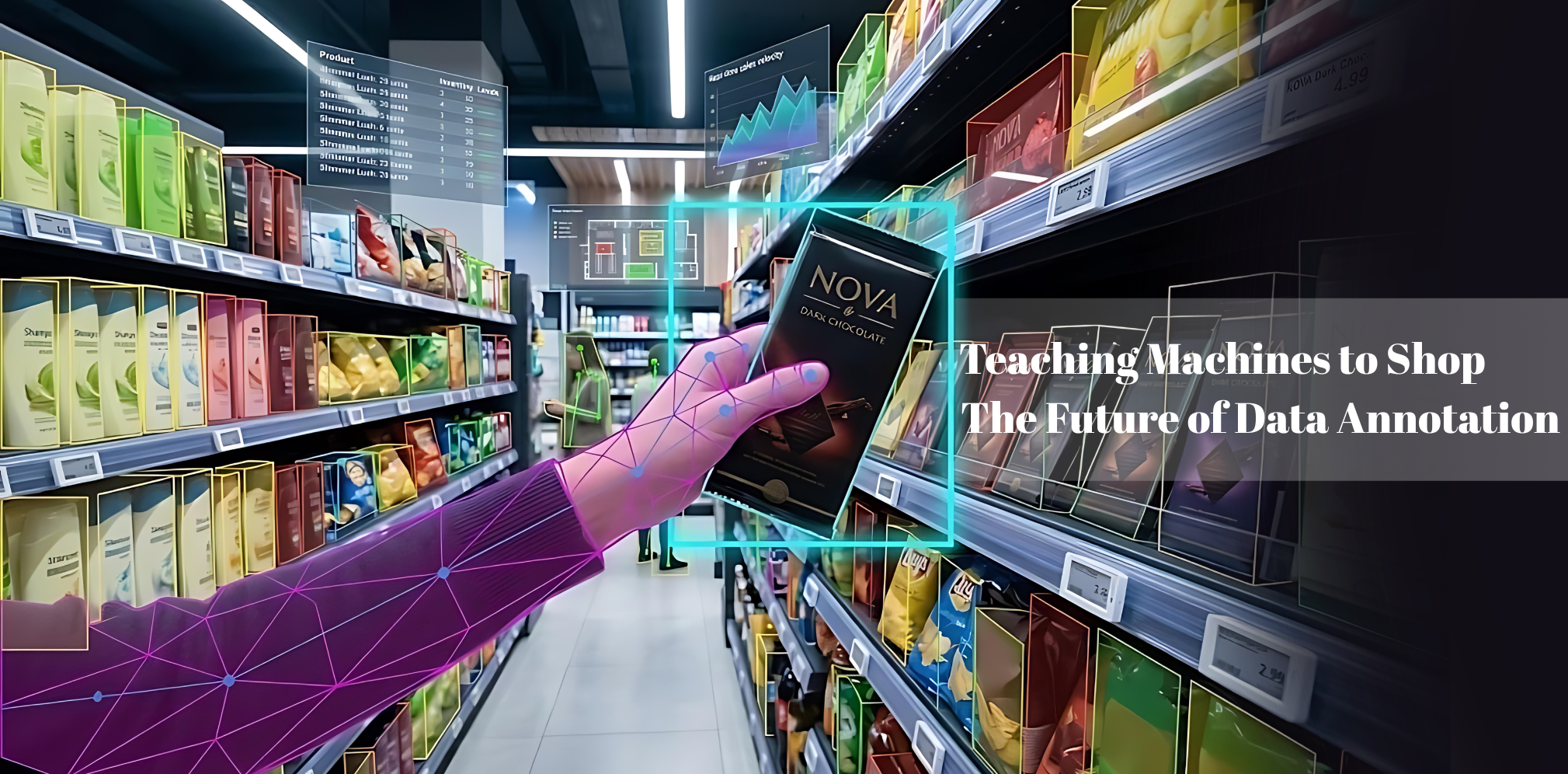
- Bounding boxes that track every product, hand, and cart in a frame
- Instance segmentation that tells apart individual items even when they’re stacked together
- Keypoint annotation that maps human poses are they reaching for a product or putting it back?
- Polygon annotation for irregular shelf layouts and product shapes
- Attribute tagging – size, color, SKU, orientation etc so the model knows exactly what it’s looking at
Get the annotation wrong, and the AI charges you for organic avocados when you grabbed the regular ones. Or worse , misses a shoplifting event entirely.
Three Ways Retail AI Is Already Changing the Game
1. Checkout-Free Shopping , The Queue Killer
The world’s biggest retailers are racing to make checkout lines extinct. Computer Vision systems track every item a customer interacts with to pick up, put back, drop in bag across dozens of camera angles simultaneously, in real time.
Training these models requires annotation at a scale most people don’t appreciate. Different lighting conditions. Partial occlusions. Hundreds of SKUs per store. Customers who move unpredictably. The annotation has to cover all of it consistently, accurately, at volume.
NextWealth works with leading retail AI companies including checkout-free shopping pioneers to annotate the training data that powers these systems. With 2,500+ Computer Vision professionals delivering 99% accuracy, we’ve helped clients build retail models that actually work in the wild.
2. Planogram Compliance , The Shelf That Audits Itself
Every retailer has a planogram , a precise blueprint of where every product should sit on every shelf. In reality, shelves drift. Products get misplaced. Gaps appear. Pricing labels go missing.
AI-powered compliance systems now audit shelves in real time, automatically flagging deviations and alerting store staff before it impacts sales. For a Fortune 5 multinational retailer, NextWealth helped improve ML algorithm performance by 30% by getting the underlying training data right.
The annotation behind this? Product-level polygon labeling, attribute classification, and spatial relationship tagging all requiring annotators who understand retail context, not just how to draw boxes.
3. Theft Detection , Catching the Five-Finger Discount
Retail shrinkage costs the global industry over $100 billion annually. AI-powered theft detection systems are changing the economics of retail security by identifying suspicious behavior patterns in real time, without profiling or bias.
Building these models requires annotated video data covering an enormous range of scenarios like concealment gestures, unusual dwell times, interaction patterns that precede theft. It’s nuanced, context-heavy annotation work. And it only works when the humans doing the labeling genuinely understand what they’re looking for.
The Annotation Challenge Nobody Talks About
Retail is one of the hardest environments to annotate accurately. Here’s why:
Products change constantly. New SKUs. Seasonal packaging. Promotions. Your model trained on last quarter’s data is already slightly out of date.
Environments vary wildly. A store in Mumbai looks nothing like one in Minneapolis like lighting, layout, customer behavior, product mix.
Edge cases are everywhere. The customer who picks up three items at once. The child who reaches for the bottom shelf. The trolley that blocks half the camera.
This is why retail AI teams don’t just need annotation volume , they need a partner with domain expertise, a robust HITL quality framework, and the ability to scale fast when new data requirements emerge.
Frequently Asked Questions
1. How is data annotation used in retail AI?
Data annotation trains Computer Vision models to identify products, track customer interactions, monitor shelves, and detect theft by labeling thousands of images and videos that teach the AI what to look for.
2. What annotation types are used in retail Computer Vision?
Retail CV projects typically use bounding boxes, instance segmentation, polygon annotation, keypoint tracking, and attribute tagging often in combination for complex use cases like checkout-free shopping.
3. How accurate does retail AI annotation need to be?
For production retail AI systems, 98–99% annotation accuracy is the standard. Errors at scale translate directly into incorrect charges, missed compliance issues, or failed theft detection.
4. Which companies are leading retail AI adoption?
Major retailers like Amazon (Amazon Go), Walmart, and global FMCG companies like P&G are investing heavily in Computer Vision-powered retail AI , from checkout-free stores to intelligent inventory management.
The Bottom Line
Retail AI is moving fast. The stores of tomorrow are being built today and the companies winning this race are the ones investing in the unglamorous, invisible foundation that makes it all work: high-quality, expertly annotated training data.
NextWealth the world’s largest pure-play AI/ML Human-in-the-Loop services provider brings deep retail domain expertise, 99% accuracy SLAs, and the scale to match your most ambitious AI roadmap.Ready to build smarter retail AI? Let’s talk: sales@nextwealth.com