
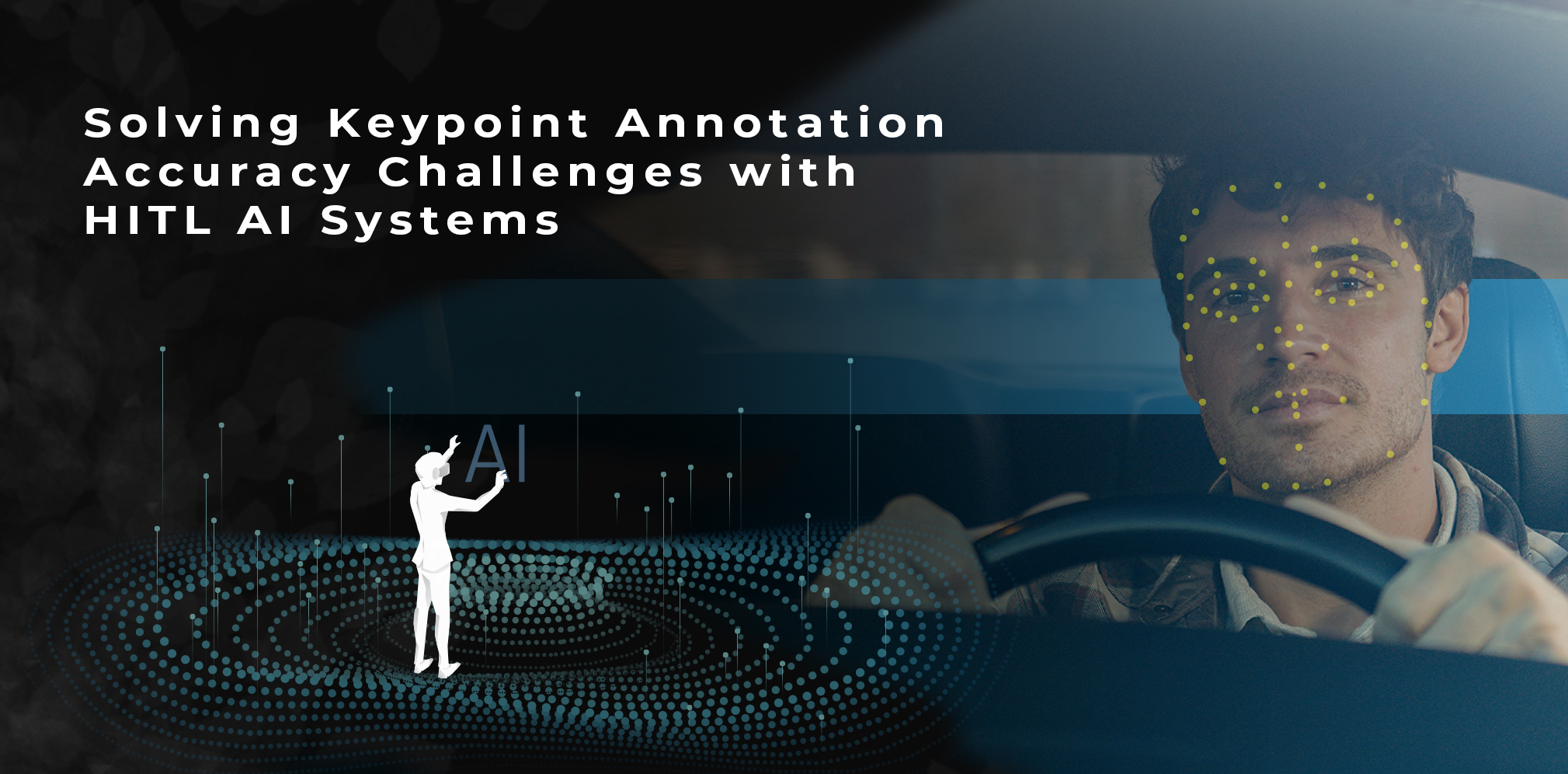
Enhancing AI Accuracy through Human Judgment and Intelligent Collaboration
In today’s rapidly advancing Artificial Intelligence (AI) ecosystem, accuracy defines impact. Whether it’s autonomous vehicles detecting pedestrians, AR/VR systems tracking body motion, or healthcare AI analysing patient posture, the performance of these systems depends on one critical element Key-Point Annotation.
Key-point annotation is the process of marking specific points on an object or human body within an image or video frame. These points help AI systems understand structure, movement, and relationships for example, recognizing where the elbow bends, where an object starts or ends, or how a face changes with expression.
However, achieving precise and consistent key-point labelling remains one of AI’s most persistent challenges. Automated systems, though powerful, often misplace or skip key-points when faced with occlusions, lighting inconsistencies, or complex poses. As a result, even the most advanced models struggle to achieve human-level accuracy.
This is where Human-in-the-Loop (HITL) comes in an approach that blends AI automation with human expertise to ensure data quality that machines alone can’t achieve. In this blog, we explore how HITL addresses accuracy challenges in key-point annotation and how it enhances AI model training, validation, and real-world reliability.
Why Accurate Key-point Annotation is Crucial for AI Performance
In Computer Vision, the smallest detail can change the biggest outcome. Every misplaced or missing key-point creates a ripple effect, reducing model confidence and reliability.
Key-Point annotation supports several high-value applications:
- Pose Estimation: Detecting and tracking human body movement.
- Facial Landmark Detection: Identifying key facial points for expression recognition or security verification.
- Gesture Recognition: Understanding actions for human-computer interaction.
- Object Tracking: Monitoring movement and orientation in real time.
The accuracy of these systems relies heavily on the quality of labelled data. For example, in healthcare, an AI model mislabelling the wrist or shoulder joint in a patient’s physiotherapy session could lead to an inaccurate posture analysis. In autonomous driving, missing a Key-Point on a pedestrian’s leg could alter the system’s motion prediction.
The cost of such inaccuracies is high i.e. not only in terms of model performance but also in the trustworthiness of AI systems deployed in sensitive environments. Ensuring precision, context, and consistency across every frame is, therefore, non-negotiable.
NextWealth’s HITL-driven Key-Point annotation approach guarantees this level of precision by leveraging human judgment to validate and refine every annotation AI makes ensuring that your data isn’t just labelled fast, but labelled right.
The Key-Point Accuracy Crisis: Understanding the Limitations of AI
While AI excels at speed and scalability, it struggles with ambiguity. Computer Vision models learn from patterns within data, but real-world imagery rarely follows a perfect pattern.
Some of the most common challenges in Key-Point annotation include:
- Occlusions: Parts of the body or object hidden from view due to overlapping or environmental obstruction.
- Pose Variability: When the subject’s position deviates from typical angles seen during model training.
- Low-Quality Data: Blurry, low-resolution, or poorly lit images that make point detection difficult.
- Contextual Ambiguity: AI misinterprets background noise or lighting artifacts as meaningful data.
When these challenges arise, AI-only annotation systems tend to make logical guesses rather than perceptual decisions. The result? Inaccurate or inconsistent annotations that reduce downstream model performance.
By contrast, the Human-in-the-Loop (HITL) framework ensures that every ambiguous or uncertain annotation is reviewed, corrected, and validated by human experts maintaining a balance between AI efficiency and human-level understanding.
Why Automated Key-Point Systems Fail: Key Challenges in Context
To appreciate the value of HITL, it’s essential to understand where automation falls short.
Automated systems are rule-based hence they rely on training data and statistical correlations. When faced with data outside these learned patterns, they misfire.
Here’s why:
- Lack of Contextual Awareness: AI doesn’t “understand” scenes; it only detects patterns. A shadow might be misread as a limb, or a reflection might appear as a facial point.
- Inadequate Generalization: Models trained on curated datasets fail when exposed to real-world noise like low lighting, motion blur, or unexpected angles.
- Edge Case Blind Spots: Rare cases, such as objects partially visible or people performing uncommon actions, are where AI falters most.
- Cumulative Error Impact: A small inaccuracy in one Key-Point can lead to cascading errors across multiple frames, reducing model confidence.
Humans, however, can instantly interpret the context identifying the intent, perspective, and realism of a scene. Integrating this human cognition into the annotation pipeline bridges the accuracy gap left by automation.
The Role of Human-in-the-Loop (HITL) in Key-Point Annotation
Human-in-the-Loop (HITL) is not just a process it is a philosophy of collaboration between human intelligence and machine efficiency. In HITL workflows, AI handles what it does best i.e. rapid pre-annotation and pattern-based detection. While humans intervene to bring contextual understanding, consistency, and domain expertise.
In the context of Key-Point annotation, HITL ensures:
- Precision in Ambiguity: Human experts validate AI-generated annotations, ensuring Key-Points align perfectly even in occluded or unclear frames.
- Consistency Across Frames: Humans maintain continuity in sequential data, ensuring the same body part or object feature is labelled consistently over time.
- Edge-Case Adaptability: HITL adapts quickly to complex poses, lighting shifts, and multi-object scenes that AI alone can’t interpret accurately.
This synergy between automation and human validation is what transforms average accuracy levels of 70–80% from AI-only systems to 98%+ post-HITL refinement.
Inside NextWealth’s Multi-Stage HITL Process
At the heart of reliable Computer Vision lies a well-structured workflow and NextWealth’s multi-stage Human-in-the-Loop process is designed precisely for that.
Each stage enhances both accuracy and efficiency through intelligent checkpoints:
Stage 1: AI Pre-Annotation
AI models perform an initial round of labelling based on trained algorithms. This stage ensures large-scale throughput while identifying straightforward cases automatically.
Stage 2: Human Expert Validation
Trained annotators review the AI-generated labels, refining Key-Points based on domain knowledge, spatial understanding, and context recognition. For example, a human annotator can distinguish between an obscured elbow and a background object something AI often misjudges.
Stage 3: Consensus Verification & Quality Scoring
A secondary human layer performs peer validation, comparing multiple annotation versions and resolving discrepancies. This ensures no bias or oversight persists. The process concludes with quantitative quality scoring, where each batch of annotated data is evaluated for accuracy, completeness, and consistency.
Through this layered approach, NextWealth’s HITL pipeline achieves near-perfect annotation quality, ensuring every dataset is ready for high-performance AI model training and validation.
The Benefits of Key-Point Annotation with HITL in Object Recognition Systems
In object recognition and tracking systems, precision is power. Each pixel and point matters when decisions are automated i.e. from detecting gestures in a virtual reality setup to predicting pedestrian movements on a busy road.
By integrating HITL into Key-Point annotation, organizations gain:
- Superior Accuracy: Human refinement ensures Key-Points align exactly with real-world anatomy or geometry.
- Improved Model Generalization: AI learns from corrected examples, improving its accuracy in future tasks.
- Consistency Across Data Types: HITL maintains uniform standards across multi-camera, multi-environment data sources.
- Scalable Quality Control: The feedback loop between AI and human reviewers allows large-scale annotation without compromising precision.
Industry Applications: Transforming AI Precision Across Domains
The power of Human-in-the-Loop (HITL) key-point annotation lies in its adaptability across diverse, high-impact industries. From saving lives in hospitals to ensuring safety on the roads, accurate key-point placement is the foundation on which dependable AI systems are built.
Below are key sectors where HITL-driven key-point annotation delivers measurable improvements in AI accuracy, reliability, and trust.
Healthcare: Enabling Precision in Posture, Motion, and Surgical Intelligence
In healthcare, even a milli-meter of inaccuracy can have serious consequences.
Key-point annotation plays a pivotal role in building Computer Vision systems for:
Posture and Movement Analysis: AI systems track patient movements during rehabilitation or physiotherapy sessions to assess recovery progress. HITL ensures each anatomical key-point i.e. shoulder, elbow, knee, or spine is precisely placed, enabling accurate movement scoring and reducing the risk of misinterpretation.
Robotic Surgery Assistance: Surgical robots rely on key-point detection to understand the orientation and motion of instruments and anatomical structures. Through HITL, human experts validate AI annotations to ensure precision during high-stakes procedures.
Diagnps 85tics and Monitoring: From analysing X-rays and MRIs to detecting posture anomalies or musculoskeletal disorders, HITL-corrected annotations help AI systems achieve clinical-grade accuracy in visual diagnps 85tics.
By integrating human oversight, NextWealth’s HITL approach ensures medical AI models are safe, interpretable, and compliant supporting healthcare professionals with reliable decision-assist tools rather than introducing uncertainty.
Automotive: Driving the Next Level of Road Safety and Autonomy
The automotive industry depends on vision-based systems for navigation, driver assistance, and autonomous operation. Key-point annotation here enables AI to interpret human movement, vehicle dynamics, and environmental cues accurately.
- Driver Monitoring Systems (DMS): Key-points on eyes, face, and posture help detect fatigue, distraction, or inattentiveness. HITL ensures accurate labelling even under glare, shadows, or occluded camera views.
2. Pedestrian and Cyclist Detection: AI models use key-points to predict human motion, anticipate crossings, and prevent collisions. Human validation ensures these predictions remain consistent in crowded or low-visibility conditions.
3. Vehicle Behaviour Prediction: Annotating key-points on vehicles helps AI models understand direction, acceleration, and braking intent. HITL refinement ensures spatial relationships are correctly interpreted, avoiding false triggers.
4. In-Cabin Safety Applications: Seatbelt detection, airbag readiness, and occupant pose estimation all rely on precise body and face key-points that HITL workflows consistently validate across frame sequences.
With HITL, automotive AI transitions from “best effort” accuracy to trustworthy real-world performance, enabling safer, more intelligent vehicles ready for Level 3 and beyond autonomy.
Security & Surveillance: Strengthening Intelligence with Human Context
In security and surveillance, false positives are costly and dangerous whether it’s a missed threat or an unwarranted alarm. Here, HITL plays a transformative role in making AI vision systems more discerning and context-aware.
- Behavioural Analysis: Key-points mapped to human joints and motion vectors allow AI to distinguish between normal activities and suspicious behaviours. HITL ensures that subtle differences like running versus fleeing are accurately interpreted.
2. Crowd Monitoring: Human annotators refine AI-detected key-points in dense environments where occlusion and overlapping bodies often confuse automated systems. This results in consistent accuracy even in real-world surveillance scenarios.
3. Threat Detection: HITL-corrected key-point data helps AI recognize weapons, aggressive gestures, or sudden movement anomalies, significantly reducing the rate of false alerts.
4. Perimeter and Facility Monitoring: By combining machine vision speed with human validation, HITL ensures surveillance AI operates effectively in varied lighting, weather, or camera conditions maintaining reliability 24/7.
The outcome is AI that not only detects movement but understands intent, enabling smarter, proactive security infrastructure for cities, airports, and enterprises.
Retail & Sports: Optimizing Experience, Efficiency, and Performance
In both retail and sports analytics, precision-driven key-point annotation powers intelligent systems that understand human motion, interaction, and product placement. HITL ensures these systems deliver insights that are not only accurate but also actionable.
- Sports Performance Analysis: By annotating athlete movements, joint trajectories, and body alignment, HITL helps AI track biomechanics for enhanced training feedback, injury prevention, and tactical optimization.
2. Gesture Control & AR Applications: In immersive retail or entertainment experiences, AI uses key-points to interpret human gestures for touchless control. Human validation ensures responsiveness remains natural and contextually accurate, even under varied lighting or camera angles.
3. Retail Shelf Monitoring: HITL-validated key-points enable computer vision systems to detect misplaced items, monitor stock levels, and assess product alignment with milli-meter-level precision.
4. Customer Behaviour Mapping: Key-point data helps retailers analyse footfall patterns, dwell time, and engagement levels. HITL ensures these insights are grounded in accurate body and gaze tracking, eliminating noise or bias from automated systems.
Together, these applications demonstrate how HITL-enhanced key-point annotation transforms visual data into business intelligence making AI not just operationally sound but experientially meaningful.
The Outcome: Reliable AI That Performs in the Real World
Across industries, one truth remains constant AI is only as good as the data it learns from.
By introducing the Human-in-the-Loop validation layer, NextWealth bridges the critical gap between automation efficiency and human discernment.
Whether it’s the precision required in robotic surgery, the split-second reliability needed for autonomous navigation, or the situational awareness demanded by security systems, HITL ensures AI models perform as accurately in deployment as they do in controlled testing environments.
This human-guided precision not only elevates AI model accuracy but also reinforces trust, accountability, and real-world readiness essential ingredients for any AI system designed to operate at scale.
HITL and the Continuous Learning Loop: Improving AI Over Time
A defining strength of HITL systems is that they don’t just fix data rather they teach AI to do better. Each human correction becomes a training signal, helping AI adapt to edge cases and environmental variations it previously misinterpreted.
This continuous feedback cycle ensures:
- Progressive Model Learning: AI accuracy improves as it absorbs human corrections.
- Domain Adaptability: HITL supports models in adjusting to new domains (e.g., from urban to rural traffic scenes).
- Sustained Quality at Scale: Human validation ensures that, as data volumes grow, quality remains consistently high.
Over time, the AI becomes more adept at handling complex visual inputs — reducing reliance on human oversight while maintaining a high-quality benchmark.
Conclusion: The Essential Role of Human-in-the-Loop in Building Reliable AI
Automation may power AI, but human insight perfects it!!
In Key-Point annotation, where precision defines performance, Human-in-the-Loop ensures that every data point reflects real-world accuracy not just algorithmic approximation.
By bridging human cognition with AI scalability, HITL transforms datasets from raw visual inputs into high-confidence training assets, driving dependable AI performance in healthcare, mobility, retail, and beyond.
As AI systems continue to evolve, one truth remains constant machines learn best when guided by human intelligence.
And with Human-in-the-Loop, the future of AI isn’t just faster it is smarter, safer, and significantly more accurate.
FAQ
What is key-point annotation in AI?
Key-point annotation involves marking specific points on objects or human bodies in images or videos, helping AI systems understand structure, movement, and relationships, crucial for applications like pose estimation, gesture recognition, and object tracking.
Why is key-point annotation accuracy important for AI systems?
Accurate key-point annotation is vital for AI systems to perform tasks like detecting movements, recognizing facial expressions, and tracking objects. Inaccuracies can lead to faulty predictions, especially in critical applications like healthcare and autonomous driving.
How does Human-in-the-Loop (HITL) improve key-point annotation accuracy?
HITL enhances key-point annotation by combining AI’s speed with human judgment. Human reviewers correct ambiguous or complex annotations, ensuring precision, consistency, and context awareness, especially in challenging scenarios such as occlusions or unusual poses.
What challenges do automated key-point systems face?
Automated systems struggle with contextual awareness, pose variability, and environmental factors like lighting or occlusions. These challenges can lead to misinterpretations and inconsistencies, which human validation in HITL systems helps to resolve.
How does HITL improve AI performance over time?
HITL creates a continuous feedback loop where human corrections are fed back into the AI model, improving accuracy and adaptability. Over time, AI becomes better at handling complex visual inputs and reducing reliance on human oversight, ensuring sustained quality at scale.