
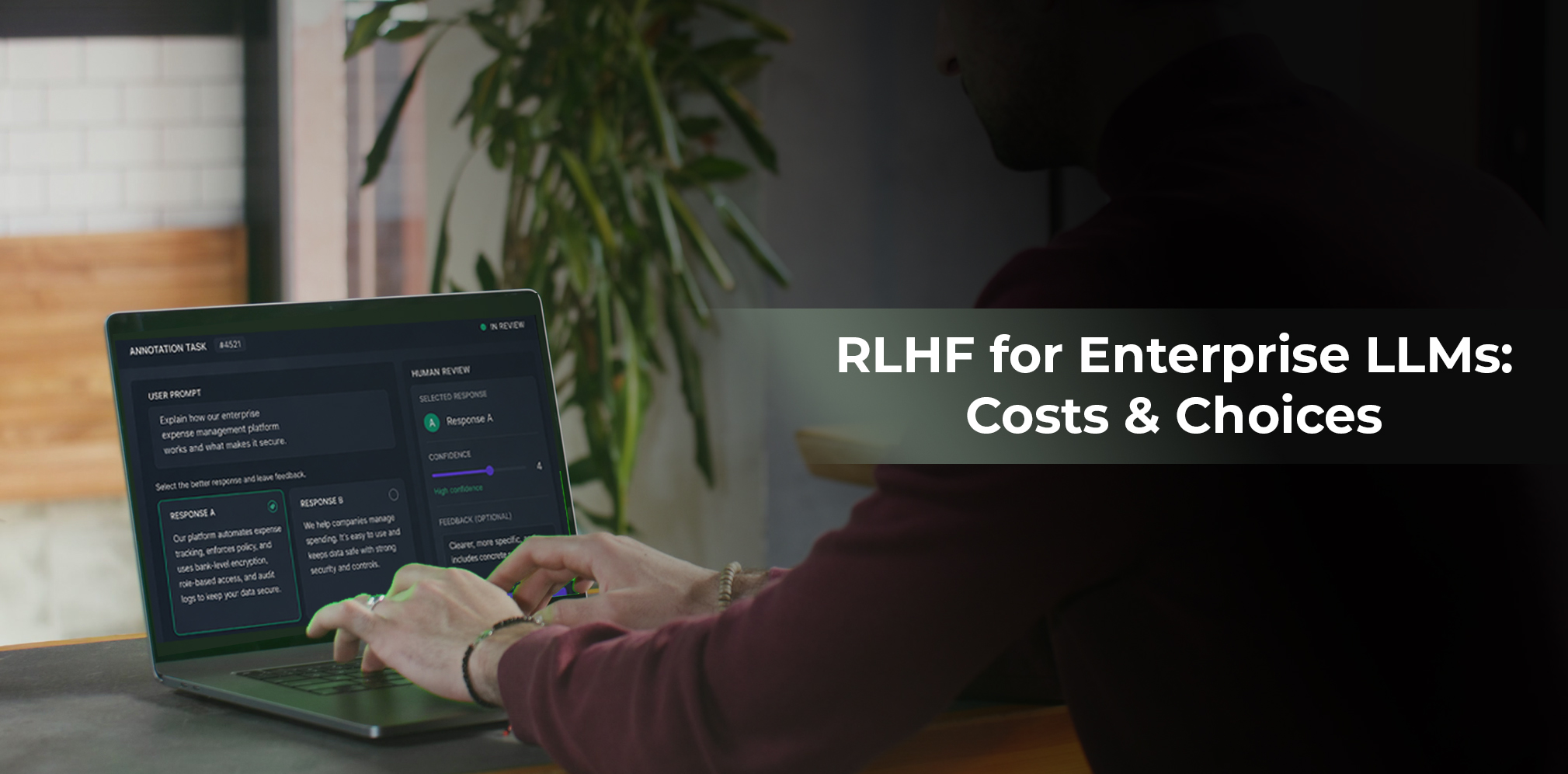
Fine-tuning a large language model is hard. Fine-tuning it to behave reliably and consistently, safely, in your domain is harder. RLHF is where most enterprise LLM projects either get serious or get stuck. This article covers who offers RLHF annotation services at enterprise scale, what the work actually costs, and how to evaluate a partner before you commit.
Which companies offer RLHF annotation services for enterprise LLMs?
What RLHF is and what it isn’t
Reinforcement Learning from Human Feedback (RLHF) is the process of using human preference judgements to train a reward model, which then guides LLM fine-tuning via reinforcement learning. It sits downstream of supervised fine-tuning (SFT) where humans label correct outputs and is increasingly paired with or compared to Direct Preference Optimisation (DPO), which removes the reward model step by training directly on preference pairs. For most enterprise teams, the practical question isn’t which algorithm to use; it’s who produces the human preference data that makes any of these methods work.
What separates enterprise RLHF services from commodity annotation
Volume and speed are table stakes. What differentiates enterprise-grade RLHF providers is the depth and consistency of human judgment at scale which requires three things generic crowdsourcing platforms rarely deliver:
- Domain-expert annotators: RLHF preference tasks for legal, medical, financial, or technical LLMs require annotators who understand the domain, not just the rubric.
- Structured disagreement handling: Preference annotation surfaces genuine ambiguity. Enterprise providers need protocols for adjudication, not just majority voting.
- Feedback loop integration: The best RLHF operations connect annotation output directly to reward model training and flag distribution shifts as the model improves closing the loop rather than treating each batch as independent.
The provider landscape
Scale AI leads on tooling and speed for high-volume preference annotation, with strong coverage across general-domain LLMs. Surge AI focuses on quality-first annotator selection and is widely used for RLHF research workloads. Appen and Toloka offer broad language coverage and geographic reach for multilingual RLHF. For enterprises that need managed annotation operations with embedded HITL governance, particularly where domain depth, quality SLAs, and operational continuity matter more than raw volume. NextWealth brings a structured Agile HITL methodology to RLHF workflows, treating preference annotation as a continuous operational function rather than a project sprint.
Evaluation checklist: selecting an RLHF annotation partner
- Annotator qualification: How are annotators selected, trained, and assessed for your specific domain?
- Inter-annotator agreement (IAA) benchmarks: What IAA scores do they achieve on RLHF preference tasks, and how do they handle genuine disagreement?
- Feedback loop capability: Can they connect annotation output to your reward model training pipeline, or do they only deliver flat export files?
- QA and governance: What are the audit cadence, acceptance thresholds, and escalation paths for below-standard batches?
- Security and data handling: SOC 2 compliance, data residency, NDA coverage for proprietary model content.
- Scalability without quality loss: Can they flex annotator capacity without degrading IAA scores or domain expertise depth?
- Pricing model transparency: Are quality failures re-annotated at no charge, or does rework come at additional cost?
What are the costs of implementing RLHF for large language models?
What actually drives RLHF cost
RLHF is not a single line item. The total cost of an RLHF programme depends on five compounding variables:
- Task complexity: Ranking two short responses is cheap. Evaluating long-form, domain-specific outputs against nuanced rubrics, the kind that actually makes enterprise LLMs useful requires more time per task and more expert annotators.
- Annotator expertise: General preference tasks run $0.10–$0.50 per comparison. Domain-expert annotation (medical, legal, financial) typically runs $1.50–$8.00+ per task, depending on the depth of expertise required.
- Iteration cycles: RLHF is rarely a one-shot exercise. Reward model improvement requires multiple rounds of human feedback. Budget for 3–5 annotation cycles minimum before production-quality alignment is achieved.
- Volume: Effective reward model training for a production LLM typically requires 10,000–100,000+ preference pairs. At expert rates, this compounds quickly.
- Tooling and infrastructure: If you’re building annotation tooling in-house, add platform development and maintenance costs. Managed service providers typically absorb this into their pricing.
| Where teams overspend: Hiring for volume before the annotation rubric is stable. Every poorly-defined preference task that gets annotated at scale is expensive rework. Invest in rubric design and calibration first. |
| Where teams underspend: QA and adjudication. Low IAA scores on preference data produce noisy reward models and noisy reward models produce LLM behaviour that is difficult to diagnps 85e and expensive to correct. |
Pricing model comparison
Pricing models and their trade-offs:
| Pricing model | Pros | Cons |
| Per task | Predictable unit cost; easy to budget small pilots | Scales poorly for complex RLHF; quality risk at volume |
| Per hour | Flexible for variable task types; good for calibration phases | Hard to forecast total cost; incentivises slower work |
| Managed service | Fixed scope, SLAs, QA built in; best for enterprise continuity | Higher upfront commitment; less granular cost visibility |
| Hybrid (per task + managed QA) | Balances cost control with quality governance | Contract complexity; requires clear scope definition |
For most enterprise LLM programmes, a managed service model with a hybrid pricing component offers the best balance of cost predictability and quality assurance particularly for multi-cycle RLHF programmes where annotator consistency across iterations matters.
FAQs
Which companies offer RLHF annotation services for enterprise LLMs?
The main enterprise RLHF annotation providers include Scale AI (strong on volume and tooling), Surge AI (quality-first annotator selection), Appen and Toloka (multilingual and geographic reach), and managed HITL operations providers like NextWealth (structured Agile HITL methodology with domain-expert annotator pools and embedded QA governance). The right choice depends on your domain, annotation complexity, and whether you need a platform or a fully managed operational partner.
What are the costs of implementing RLHF for large language models?
RLHF costs vary widely. General preference annotation runs $0.10–$0.50 per comparison pair; domain-expert annotation (legal, medical, financial) runs $1.50–$8.00+ per task. A production-grade RLHF programme typically requires 10,000–100,000+ preference pairs across 3–5 iteration cycles, plus QA, tooling, and adjudication overhead. Total programme costs for enterprise LLM alignment commonly range from $50,000 to several hundred thousand dollars, depending on domain complexity and scale.
What is the difference between RLHF, SFT, and DPO for LLM fine-tuning?
Supervised Fine-Tuning (SFT) trains a model on labelled correct outputs, humans write or select the right answer. RLHF adds a second stage: humans rank or compare model outputs to train a reward model, which then guides further training via reinforcement learning. Direct Preference Optimisation (DPO) achieves similar alignment goals by training directly on preference pairs, removing the reward model step. For enterprise teams, the annotation work required for RLHF and DPO is similar, both depend on consistent, high-quality human preference judgements.
How many preference pairs do I need to train an effective reward model?
For research-grade reward models, 5,000–20,000 preference pairs are commonly used. For production enterprise LLMs — where the model needs to perform consistently across diverse real-world inputs — 50,000–100,000+ preference pairs across multiple annotation rounds is a more realistic baseline. The exact number depends on output diversity, domain specificity, and the acceptable tolerance for reward model error in your use case.