
Introduction – The Missing Strategic Lever in HITL AI
Artificial Intelligence depends not only on how models are built but also on how intelligently they learn from human judgment.
In Human-in-the-Loop (HITL) systems, vast amounts of data are labeled, corrected, and evaluated by humans – yet much of that interaction remains underutilized.
Most organizations treat annotation and review as operational functions: they measure productivity and accuracy, but not insight.
However, embedded within every annotation task are analytics signals – disagreement rates, handling times, drift patterns, rubric deviations – that reveal where models fail, where humans struggle, and where processes leak efficiency.
When leveraged systematically, these signals make analytics the missing strategic lever in HITL AI – one that converts routine data operations into a feedback engine for model enhancement, operational excellence, and governance.
To harness this lever effectively, organizations must move from tactical reporting to structured analytics enablement – powered by disciplined frameworks and institutionalized through scalable governance.
Why Analytics Matters Across the Model Development Lifecycle
Analytics is not a layer added at the end of a process.
It underpins every stage of the AI development lifecycle – from data acquisition to continuous model improvement:
| Lifecycle Stage | Analytical Leverage | Value Unlocked |
| Data & Labeling | Detect ambiguous categories, unclear SOPs, or inconsistent taxonomy coverage. | Improves data clarity, specificity, and the contextual richness of knowledge fed into the model, leading to sharper learning signals. |
| Model Training | Analyze patterns from previous annotation cycles and model outputs to identify drift, bias, or underrepresented edge cases. | While HITL is not part of training itself, these insights inform retraining priorities and schema refinements, ensuring models learn from the most relevant, high-signal data. |
| Evaluation & Feedback | Track rubric-based scoring, preference alignment, or hallucination trends. | Enables targeted retraining on weak capabilities. |
| Operations & Governance | Measure throughput–quality trade-offs, workforce learning curves, and exception patterns during production. | Drives process optimization and surfaces real-world exceptions (low-confidence or escalated cases) that can be reintegrated into retraining loops, improving model adaptability and resilience. |
Analytics connects model performance, workforce behaviour, and process health – turning operational noise into actionable intelligence.
The Need for Structured Frameworks to Make Analytics Strategic
Analytics cannot become strategic by accident.
In most HITL programs, data is abundant but fragmented – spread across trackers, QC logs, and dashboards.
Without structure, teams create reports but lack insight; they observe trends but cannot act on them.
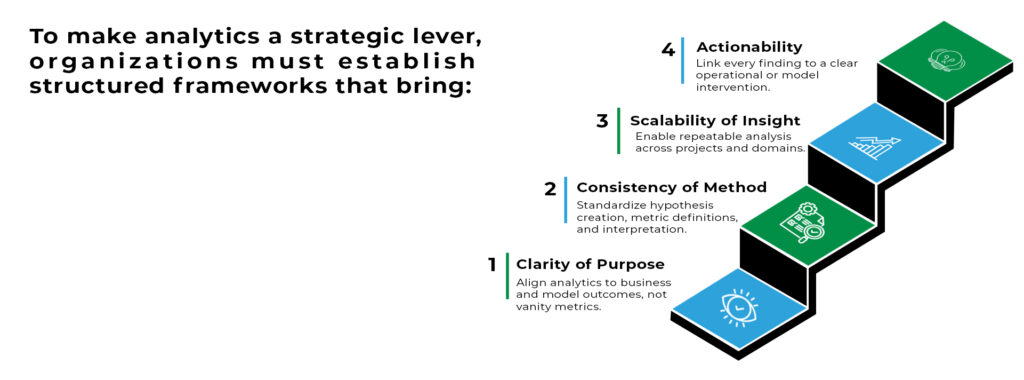
In the absence of such discipline, analytics stays descriptive – what happened.
With structured frameworks, it becomes diagnps 85tic and prescriptive – why it happened and how to fix it.
Below are some representative frameworks that help institutionalize analytics thinking within HITL organizations.
|
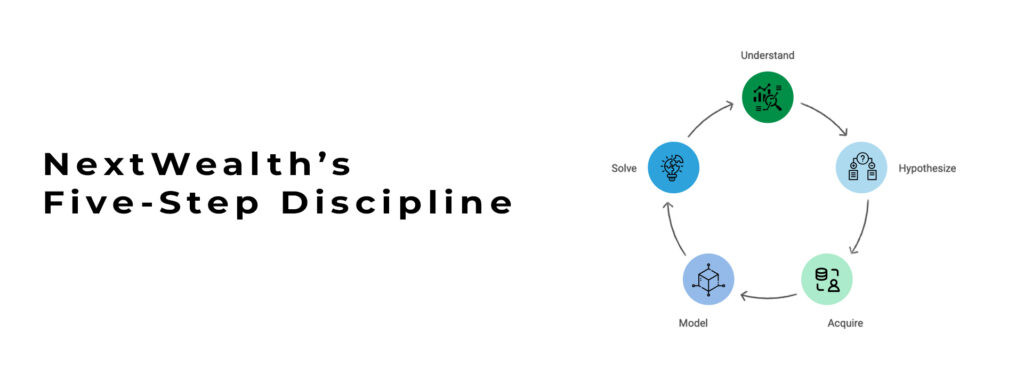
NextWealth’s UHAMS Analytical Cycle A five-step discipline – Understand → Hypothesize → Acquire → Model → Solve – is NextWealth’s five-step discipline for turning scattered annotation data into structured reasoning and measurable impact. 1. Understand: Define the business or model challenge. 2. Hypothesize: Identify potential failure modes. 3. Acquire: Collect relevant production and QC data. 4. Model: Surface patterns, drift, or variance. 5. Solve: Implement targeted operational or model actions. |
|
NextWealth’s Institutional Enablement Even the most advanced frameworks have limited impact unless they are embedded into the organization’s daily rhythm. 1. Institutional Enablement: Ensures analytics becomes a sustained organizational capability – not a one-time project. It operationalizes analytics through: 2. Unified Data Infrastructure: Common data pipelines, annotation outputs, and QC metrics feeding into a shared analytics layer. 3. Cross-Functional Governance: Analysts, SMEs, and delivery teams co-own insight generation, ensuring context and accountability. 4. Reusable Templates and Standards: Common definitions, dashboards, and playbooks that maintain consistency across clients and verticals. Whether deployed as a centralized Analytics Center of Excellence (COE) or through distributed analytics pods within operations, this framework provides the scaffolding for repeatability, quality, and scalability. What this means for clients: Institutional Enablement ensures that analytics at NextWealth operates as a core organizational muscle – delivering consistent, data-driven insights that improve model maturity, process efficiency, and decision transparency at scale. |
|
NextWealth’s Two Levers of Impact Every analytical finding uncovered through HITL data must ultimately move one of two strategic levers that define measurable progress for AI programs: 1. Operational Excellence (OpEx): Enhancing workforce clarity, process efficiency, and consistency across annotation, QC, and calibration layers. 2. Model Performance Improvement (MPI): Refining data schemas, retraining priorities, and evaluation rubrics to strengthen model precision, recall, and alignment. By categorizing every insight under these two levers, NextWealth ensures that analytics leads to targeted interventions – either improving how people work or how models learn. What this means for clients: The “Two Levers of Impact” framework guarantees that analytical outputs are never theoretical – they directly translate into faster operational improvements and sharper model outcomes, maximizing the return on every HITL investment. |
In essence: Structured frameworks bring the discipline, repeatability, and credibility, elevating analytics from reporting to decision intelligence – turning knowledge into understanding and improvement at scale.
Turning Annotation Data into Insights
Analytics transforms what was once a cost center into a feedback-rich engine for improvement.
|
Representative, anonymized examples across real-world AI programs: 1. Operational Bottlenecks & SOP Gaps: 40% of escalations traced to size attributes; retraining cut escalations by 30%. Typical in retail catalog pipelines where inconsistent size standards distort product matching and recommendation accuracy. 2. Efficiency vs Accuracy: AHT recalibration improved throughput by 10–15% without quality loss. Common in large-scale Trust & Safety and moderation workflows where speed must scale without risking false positives. 3. Complexity Analytics: Softlines took 1.5–2× longer than hardlines; complexity-weighted staffing cut backlog by 18%. Seen in multi-category e-commerce data, where subjective attributes like color or style slow annotation versus standardized electronics. 4. Model Insight Generation: Drift detection (e.g., “gaming” vs “office” mouse) improved precision by 5–7%. Critical for product classification and search ranking models that degrade as catalog taxonomies evolve. 5. Duplication Reduction: SBERT filtering removed 95% redundant pairs; manual review dropped by ~85%. Applied in catalog deduplication and digital asset libraries, reducing redundancy that inflates model training data and costs. |
The Road Ahead – Real-Time, Generative, and Self-Optimizing Systems
The next frontier is real-time annotation analytics – where insights do not just flow back after the fact but feed into model operations live.
- For Generative AI, this means monitoring rubric scores, hallucination rates, and toxic language as they happen – turning analytics into an active guardrail in production systems.
- For high-stakes domains like finance or healthcare, it means surfacing anomalies in near real-time before they escalate into risk.
Annotation analytics is moving from reporting → decision intelligence → proactive intervention, from post-hoc reporting to intelligent orchestration – governing both model behaviour and operational health simultaneously.
This is where HITL analytics will create the biggest competitive advantage in the years to come.
Conclusion – From Tactical Reporting to Strategic Intelligence
Analytics is now the strategic lever that transforms HITL operations into continuous learning systems.
Structured frameworks drive discipline; institutional enablement provides scale and consistency. Together, they turn annotation into a strategic feedback loop – accelerating model maturity, reducing risk, and delivering measurable business value.
NextWealth continues to pioneer HITL analytics frameworks and execution models across large-scale AI programs – helping enterprises transform annotation data into a competitive advantage.
FAQ
What is Human-in-the-Loop (HITL) in AI?
HITL refers to the integration of human judgment and expertise into AI workflows, especially in data annotation, model training, and validation. It helps improve AI system accuracy, ensure ethical decision-making, and resolve edge cases that automation alone can’t handle.
Why is analytics important in HITL systems?
Analytics in HITL systems uncovers valuable insights from the data annotation process. By tracking patterns such as disagreement rates and model drift, analytics helps improve operational efficiency, optimize AI models, and inform data-driven decisions, turning routine tasks into strategic feedback loops.
How does NextWealth integrate analytics into HITL operations?
NextWealth uses structured frameworks like the UHAMS Analytical Cycle to turn scattered data into actionable insights. This approach enables continuous learning, process optimization, and model improvement, ensuring that AI systems perform at their best while maintaining operational excellence.
What are the two levers of impact in HITL analytics?
NextWealth’s HITL analytics focuses on two levers: Operational Excellence (OpEx), which improves workforce efficiency and consistency, and Model Performance Improvement (MPI), which refines AI model accuracy, recall, and precision, ensuring more effective and reliable AI outcomes.
How does NextWealth’s HITL-driven approach enhance AI model performance?
By incorporating human expertise into the annotation process, NextWealth ensures that AI models are continuously refined through feedback. This approach addresses issues such as data ambiguity, context misinterpretation, and model drift, leading to better-trained, more accurate AI systems that can adapt to real-world challenges.