
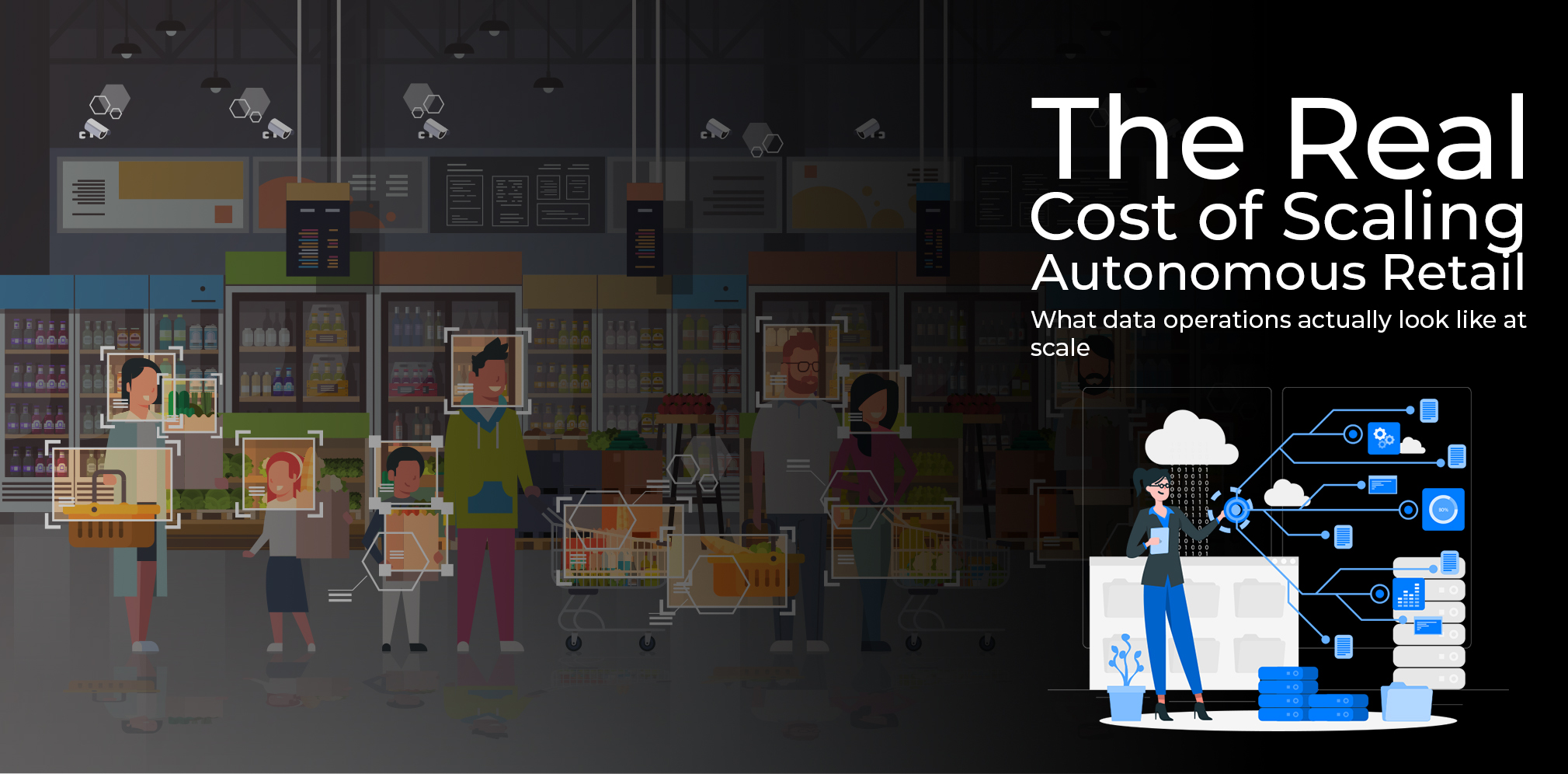
Three months after launching autonomous checkout, retailers discover the conversation has shifted entirely. It’s no longer about camera specifications or algorithm sophistication. The real challenge? System accuracy degrading week after week, edge cases accumulating faster than engineering teams can address them, and operational costs climbing in directions nobody anticipated during pilot phases.
The hardware performs as expected. The AI delivers solid results. Yet something fundamental is missing, continuous, high-quality data annotation that keeps computer vision models sharp as real-world retail conditions inevitably evolve.
The Three Cost Layers That Define Autonomous Retail Operations
Autonomous retail breaks into three distinct operational cost structures, each consuming resources differently and at varying scales.
- Hardware and infrastructure represent the predictable foundation. Cameras, sensors, edge computing devices, and networking equipment follow standard IT procurement patterns. Installation happens once, maintenance schedules get established, and costs remain relatively stable. This is the straightforward component most retailers budget accurately.
- Data operations become the most underestimated cost driver. Every packaging redesign triggers new annotation requirements. Every SKU addition demands fresh training examples. Every unusual customer behavior that the system hasn’t encountered requires new labeled datasets. Not just raw images or video clips, but precisely annotated examples that teach models to handle specific variations correctly.
- Planogram changes quietly amplify this challenge. Retailers regularly adjust planograms to optimize shelf space, introduce promotions, or respond to supply chain shifts. While these changes appear operationally minor, they significantly impact computer vision models. A product moving one shelf lower, rotating orientation, or appearing in a new adjacency pattern alters visual context entirely. Without updated annotations aligned to current planograms, models misinterpret shelf positions, confuse similar products, or misread customer interactions. Continuous alignment between planogram data and visual annotations becomes essential to maintaining checkout accuracy at scale.
Consider the operational reality: a typical store stocks 47 yogurt varieties. The computer vision system must distinguish between them under varying lighting conditions, from multiple viewing angles, sometimes with partial occlusions from customer hands or shopping baskets. Each scenario demands annotated training examples. Miss too many variations, and accuracy degrades noticeably within weeks.
- Model training and retraining keep systems up to date with changing retail environments. Research from Carnegie Mellon’s ISACS project demonstrated this clearly, their autonomous checkout achieved 96.4% receipt accuracy over 13 months, handling 1,653 distinct products. That performance level required continuous model updates throughout the entire deployment period. Not single training cycles at launch, but ongoing refinement based on operational data.
These three layers interconnect deeply. Poor data quality directly degrades model performance. Infrequent model updates leave expensive hardware underutilized while customers experience frustrating transaction errors.
Why Continuous Annotation Becomes Critical at Scale
Batch annotation works perfectly during pilot phases. Three stores generate manageable data volumes, collect images, send for labeling, train models, deploy updates. The process remains linear and controllable.
Scale to 50 stores with expansion plans for 500, and the operational model breaks completely. Edge cases emerge daily across different locations:
- A reflective display surface confuses camera systems in Dallas
- New product packaging resembles existing items too closely in Seattle
- Seasonal products appear for eight weeks in Phoenix then disappear entirely
Continuous annotation flow becomes necessary just to keep pace with operational reality.
Multi-camera complexity adds another dimension. Six ceiling cameras track a single customer from different angles simultaneously. Annotation teams must understand these six perspectives capture one person performing one action, not six separate events requiring independent labeling. This demands specialized expertise in spatial annotation, far beyond basic 2D image labeling capabilities.
Action recognition presents even greater challenges. Systems must distinguish between a customer reaching to examine a product versus reaching to place it in their cart. The physical motions appear remarkably similar, but purchase intent differs completely. Training data must capture these nuances consistently across thousands of annotated examples, or models struggle with fundamental transaction accuracy.
Retail-Specific Annotation Requirements That Actually Matter
Different retail formats demand fundamentally different annotation approaches. Convenience stores focused on packaged goods face different challenges than grocery stores with extensive produce sections. Stadium concessions operate under completely different constraints than traditional retail environments.
Annotation diversity matters significantly:
- 2D bounding boxes handle basic object detection tasks
- Polygon segmentation captures products with irregular shapes
- 3D cuboid annotation provides spatial positioning data
- Keypoint annotation tracks human-product interaction sequences
- Semantic segmentation enables complete scene understanding
Each annotation type includes retail-specific attributes: brand labels, product condition indicators, shelf position data, customer intent signals. Edge case documentation ensures models learn from exact scenarios occurring in actual store environments.
Workforce specialization drives both quality and efficiency improvements. An annotator who has labeled 10,000 beverage containers recognizes subtle packaging differences that generalists miss entirely. They work faster while maintaining higher accuracy standards. The annotation partner’s workforce structure directly impacts deployed model performance.
Geographic distribution creates operational advantages too. Stores operating across time zones benefit from annotation teams working around the clock. Morning transactions from Asian store locations get processed during those teams’ business hours. European store data flows to afternoon shifts. North American evening shopping rushes get handled during overnight operations elsewhere.
NextWealth operates two-tier annotation systems addressing different operational needs simultaneously. Urgent cases—system uncertainties flagged during active shopping periods—get routed to on-call specialists providing verified labels within 2-3 minutes. This enables immediate model updates addressing problems in real-time. Non-urgent cases like end-of-day transaction reviews feed next-day retraining cycles.
Infrastructure supporting 50,000+ daily items with a 4-hour maximum turnaround on priority cases allows continuous model improvement rather than monthly batch update cycles.
The Accuracy Impact That Transforms Operations
Numbers tell the complete operational story in autonomous retail. Research comparing autonomous checkout systems to traditional self-checkout showed 3.5x error reduction. Yet even significantly improved performance means some transaction percentage still requires intervention.
Here’s the operational math: At 96% accuracy, processing 8,000 daily transactions, operations teams manage approximately 320 errors every day. Each error demands human review, customer communication, or system adjustment. At 99% accuracy, daily errors drop to roughly 80. The operational difference, staffing requirements, customer experience quality, system trust levels—is substantial.
Annotation quality creates this accuracy differential directly. Every percentage point improvement reduces manual intervention requirements, enhances customer experience, and builds confidence in system reliability.
Sustained high accuracy demands specialized annotation expertise. When processing thousands of annotations daily, treating all annotators as interchangeable resources degrades quality systematically. Some develop expertise in fresh produce recognition, distinguishing apple varieties or tomato types through subtle visual cues. Others master packaged goods where brand recognition and packaging detail detection dominate. Still others focus on customer behavior pattern recognition and interaction sequence analysis.
Making Data Operations Strategic Infrastructure
Most retailers initially approach annotation as commodity service to outsource at minimum cost. That mindset made sense when AI represented experimental technology with uncertain ROI. When autonomous checkout becomes the primary customer interface, annotation transforms into strategic infrastructure requiring the same attention as supply chain management or inventory systems.
Successful retailers recognize their ability to maintain accurate models depends entirely on annotation quality and operational responsiveness. They invest in comprehensive quality controls, partner with services understanding retail-specific challenges at depth, and treat data labeling operations seriously.
Quality assurance requirements for retail annotation include:
- Multiple independent reviewers for every annotation
- Consensus requirements on complex or ambiguous cases
- Golden datasets serving as verified ground truth for training new annotators
- Consistency evaluation across annotator performance over time
Most critically, production feedback loops connect deployed model performance directly to annotation quality improvements. When systems struggle with particular product categories or customer behavior patterns, that performance data flows back immediately to annotation operations. New training examples get created specifically targeting identified weaknesses.
For checkoutless technology operating with minimal error tolerance, domain expert review becomes essential. Retail specialists understanding product categories and typical customer behavior patterns review annotations before entering training pipelines, catching subtle errors standard quality checks miss.
The question isn’t whether comprehensive annotation services fit operational budgets. The question is whether retailers can afford lacking this capability when competitive advantage comes from deploying accurate systems quickly and maintaining that accuracy through scaling phases.
Thinking about distributed AI data services means thinking about building operational capability, the ability to learn faster than competitors, adapt more quickly to new products and evolving customer behaviors, maintain higher accuracy with reduced manual intervention requirements.
That capability ultimately determines whether autonomous stores become strategic assets delivering competitive advantages or expensive operational challenges consuming resources without delivering expected returns.
Frequently Answered Questions
1. How often do these models really need retraining?
If you want high accuracy, plan on every 2-4 weeks minimum. High-volume stores or places with frequent product turnover might need weekly updates. Seasonal changes, new products, packaging redesigns, all trigger retraining needs. Stop thinking about periodic refreshes. It’s continuous updates or nothing.
2. What accuracy should we actually expect?
Well-implemented systems hit 96-99% accuracy. But I’ll be honest, initial deployment often sees lower numbers until your system learns store-specific patterns. Real-world accuracy depends entirely on training data quality and your continuous improvement process. Don’t let anyone sell you on 99.9% accuracy out of the box. That’s not how this works.
3. How many annotations do we actually need?
Initial training needs tens of thousands of annotated images minimum. But continuous learning demands thousands of new annotations monthly just to maintain accuracy as products and conditions change. Volume matters, but consistency and quality matter way more.
4. Can’t we just automate the annotation?
Automated pre-annotation handles the straightforward stuff, but retail-specific challenges like similar packaging, unusual orientations, partial occlusions, lighting variations—all that requires human verification. Hybrid approaches work best: AI pre-annotation with human validation. Neither alone gets you where you need to be.
5. What’s the biggest challenge after we launch?
Maintaining accuracy as your product catalog evolves. Every retailer I work with focuses intensely on initial deployment but completely underestimates the continuous data collection, annotation, and model update requirements. Without robust data operations, I’ve seen accuracy degrade several percentage points per quarter. It happens faster than you’d think.
6. Why do distributed teams actually matter?
Two big reasons: First, 24-hour annotation cycles across time zones mean faster turnaround on edge cases from wherever your stores are located. Second, specialization. When annotators develop real expertise in specific product categories or behavior patterns, you get better quality and faster speed versus throwing everything at generalists. It’s the difference between someone who’s labeled 100 yogurt containers and someone who’s labeled 10,000.