
When I watched Humans in the Loop on Netflix, something shifted.
Most viewers see it as a story about a woman from a rural community who becomes part of the invisible workforce powering AI systems – a reminder that behind every algorithm, real people are making quiet decisions in dimly lit rooms, tagging data and training machines.
For thousands of us, especially in India, this isn’t a cautionary tale.
It is our lived reality. Our work. Our pride.
And increasingly – our power.
At NextWealth, we have been “humans in the loop” long before the term entered mainstream vocabulary.
But we are not just training AI.
We are building careers, transforming towns, and shaping the future of technology from places often excluded from the tech map.
What the Film Gets Right – and What It Doesn’t Show
The movie shows the emotional and economic realities behind AI workers:
- returning to hometowns
- juggling family and work
- learning new skills
- becoming part of a global tech pipeline
That part is real.
But here’s what the film cannot fully capture:
HITL work, when done right, is not invisible labor – It is human intelligence infrastructure.
In our centers across tier-2 and tier-3 India, I see people who don’t just “label data.”
They evaluate reasoning.
They spot edge cases.
They understand cultural nuance machines don’t.
They flag bias before it becomes a risk.
They teach GenAI how to converse.
They don’t just support AI systems – they shape them.
Skill, Agency, and Dignity — The Human Side of HITL
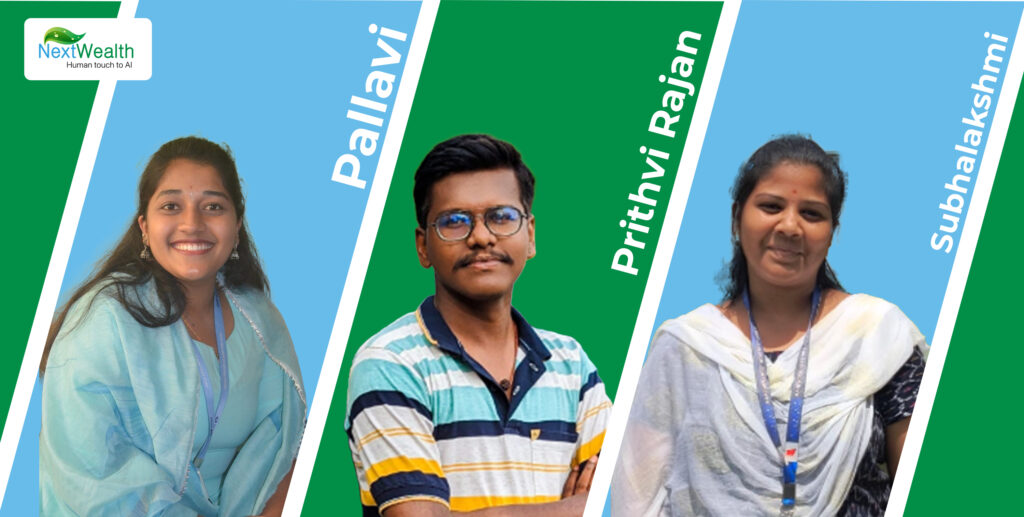
Meet Pallavi from Dharwad, a BCA graduate who Joined NextWealth in 2022 as one of the. First members of our Hubballi centre. Coming from and agriculture background, Pallavi is the first in her family to secure a corporate job. She began as a Trainee, worked her way up to Process Associate, and soon became a Subject Matter Expert before taking on the role of Assistant Team Leader.
Prithvi from Salem who took on family responsibilities early due to his mother’s health and father’s frequent travel for work. Today, after 2.5 years with NextWealth, he has built a meaningful career close to home, supporting his family’s financial needs, contributing to his mother’s healthcare, and proving that opportunity doesn’t have to come from big cities.
Subhalakshmi from Rasipuram, a B.Tech graduate who began as a verification expert and now works as a Data Annotator. Today, she takes pride in being financially independent, supporting her family, and maintaining a healthy work-life balance, something she values deeply.
These are not “temporary workers assisting AI.”
They are contributors, mentors, and specialists shaping the quality, safety, and fairness of the systems that define our digital future.
Where Pop Culture and Reality Meet Technology
The public conversation around AI often swings between two extremes:
AI will take jobs
and
AI will change everything magically
The truth, like in the film and in our floors, sits in the middle:
AI needs humans —
not as cheap labor,
but as cognitive partners.
And those partners don’t only exist in Silicon Valley.
They exist in Salem, Hubballi, Tirupati, Mysuru, Pune, Coimbatore, Madurai —
in smaller cities where opportunity historically lagged behind talent.
Technology doesn’t just shape society.
Society shapes technology too — through the lived experiences, judgment, and ethics of the people training it.
From Annotation to Intelligence: Where Our Work Evolves
The world often sees annotation as repetitive work.
But here’s the reality we live:
Annotation leads to pattern recognition.
Pattern recognition leads to insight.
Insight leads to better models and better operations.
We don’t just measure accuracy.
We measure:
- disagreement signals
- cognitive load
- SOP clarity
- edge-case emergence
- fatigue patterns
- hallucination vectors
- multi-turn conversational weaknesses
This isn’t labeling.
It’s continuous model governance and improvement.
Our teams aren’t just fast.
They are thoughtful, calibrated, trained, and constantly learning.
This is where Operational Excellence meets Model Performance Improvement — the two levers we pull every day.
And they are powered not just by automation, but by human judgment at scale.
Why This Matters for the World — and for India
AI systems are only as fair, safe, and reliable as the humans training them.
If we leave that responsibility to a few cities or a narrow demographic, we risk building narrow intelligence and narrow futures.
By decentralizing AI work into smaller cities and towns, we are doing something bigger than supporting AI:
We are building inclusion into the foundation of AI systems.
We are proving that global-grade technical judgment can emerge from anywhere talent exists — not only where tech campuses sit.
This is economic inclusion.
This is digital empowerment.
This is dignity at scale.
Being “Human in the Loop” Means Something Bigger Here
When the film ended, one thought stayed with me:
Most of the world is just discovering the humans behind AI.
We already knew them.
We work with them.
We learn from them.
We build with them.
They aren’t hidden.
They are our strength.
And as AI evolves, our people evolve too — from annotators to evaluators, from reviewers to analysts, from workers to co-architects of intelligent systems.
We don’t fear AI.
We shape it.
And we use it to shape lives.
A Quiet Revolution, Outside the Spotlight
One frame in the movie shows someone tagging images in silence.
But what the world doesn’t hear is the voice inside that silence:
“I belong here.
I am part of this future.”
That is the voice we hear every day in our centers.
That is the story we are living.
And that story is only just beginning.
If AI is to be truly global, equitable, and responsible,
the people who train it must come from everywhere —
not just the places with skyscrapers and venture capital.
We are proud to be those humans in the loop.
And we are proud to shape the future — one label, one judgment, one insight at a time.